The free class on Fall Vegetable Gardening I attended last Saturday was outstanding. I loosely adhere to the old adage 'you get what you pay for' so I was not expecting all that much from a 'free' class, especially one offered by a retail business. At most, I expected to get a few pointers and maybe hear about the latest gardening tool or product for this area. Even though Producers is an ag co-op, they are still a retailer ...in the business of selling their wares to the public. I half expected coupons to be handed out for discounts on those tools or products which, of course, would be available for purchase from the store hosting the 'free' class. The skeptic in me always looks for a catch when something is offered for free. I was pleasantly surprised on all fronts.
I have been to Producers dozens of times in the five plus years we've lived in this area but this is the first time I was there on a Saturday when the free classes are offered. I was surprised to find out I was only one of about a hundred people attending yesterday's class. I had no idea attendance would be that high and I was amazed to see the lengths the store went to accommodate the attendees. Large display racks were temporarily moved off to one side to make room for the rows of folding chairs. Two tables were set up where you entered the area ...one with registration sign in sheets and a nine-page handout of the material that would be covered in the class and the other with several carafes of coffee and trays of cookies. The store apparently goes to a lot of effort and expense to host these classes every week and I really didn't come away with the impression I had been to a sales pitch.
One of the things I learned that we will be implementing this coming year is that it's far more beneficial to rest and improve your soil during July and August than to push for production during the two hottest months. This part of Texas has relatively mild winters and it's entirely feasible most of the time to keep a garden going for nine to ten months out of the year. But just because we can doesn't mean we should. Gardens need time to rest, organic matter needs to be worked in to replenish depleted minerals and restore balance to the soil. The speaker recommended cleaning out the garden at the end of June. Remove the old crop, clear weeds and grasses and add approximately three inches of well-composted material. Work the compost in by hand or with a tiller, then saturate the garden with water to a depth of at least four inches. Let the water soak in, then saturate the ground again the next day and the day after that. By the third day, you should be able to dig down 8 or 9 inches and still have very damp soil. If the soil is not damp to that depth by the third day, you are not watering enough. When it is damp to that depth, flood it one more time to the point you have standing water, then cover it with clear plastic and leave it covered until the first week in August. The hot summer sun on the clear plastic will sterilize the saturated soil, killing any seeds, fungi or bugs that may be in it. Even in a normal summer, the temperatures under the plastic will reach at least 160 degrees during the day. That heat will help speed up the decomposition of the compost you just added.
The first week September, remove the plastic and 'fluff' the soil by hand or with a tiller. Additional store-bought compost may be added at this time if necessary. This is not the ideal time to add material from your home compost because you need to transplant seedlings to your fall garden by the middle of September and two weeks is just not enough time for typical home composted material to break down in the soil. It is also not good to work horse or cow manure into the soil because it adds too much phosphorous and will stress your seedlings.
Mid- to late-September is the ideal time to transplant seedlings into the garden. Most of us keep our thermostats set so that temperatures in our homes fluctuate very little between daytime and nighttime during the summer. So if you started your seedlings yourself in an air-conditioned setting, it's best to move them to a shaded area in the yard for a few days before you transplant them into the garden so they can become acclimated to the more extreme outdoor temperature fluctuations between daytime and nighttime.
If you purchase seedlings for your vegetable garden, look for boxy, full-leaved specimens, rather than the tallest or the one that already shows flowers. Height that is disproportionate to fullness is a plant's response to tight quarters and having to compete for sunlight. Early flowering is not a sign a vigor, it's a sign of stress ...literally according to Dr Masabni, the plant is saying, 'OMG, I'm going to die soon ...I must reproduce!' That generated some chuckles, as you can imagine, but he's right. The base instinct of all life is to survive and reproduce. Plants are no exception.
If these kinds of classes are offered through your local ag co-op or the county extension office, I urge you to take advantage of them. All of the classes won't be relevant to your situation, but take advantage of the ones that are. Knowledge is something we need to stock up on occasionally too.
Showing posts with label Pure Prepping. Show all posts
Showing posts with label Pure Prepping. Show all posts
Monday, October 17, 2011

Friday, October 14, 2011
Continuing Ed Tomorrow
Producers is the name of the big feed co-op store in Bryan. Their advertising slogan is 'Everything Ag' and that's a pretty fitting description of what you can find there. In addition to all the normal things you'd expect at a feed store, they offer free one hour seminars on Saturdays, covering a variety of subjects that would interest most any farmer, rancher or homesteader. The seminars are held at 11:00 on Saturday mornings in a small section of the store that's set up like a casual den ...complete with fireplace and big comfy chairs. The subject this weekend is Fall Vegetable Gardening and the speaker is Professor Joe Masahni, an Extension Vegetable Specialist from Texas A&M.
 I don't know if I'll learn anything new in the class, but I'm pretty sure it won't be a waste of my time. I happen to think that adding to your own store of knowledge is an essential part of being prepared. The timing for this class is great and the price is perfect. We were just talking last week about whether to plant a fall garden this year and what we should grow and since the class is free ...well, you just can't beat free!
There is always a list of errands that need to be done on Saturdays and this weekend is no different. The oil needs changing in the little truck, a trash run has to be made to the local collection station and now I have this class I want to attend in Bryan. Yeoldfurt will be tied up at the the Appleseed shoot in Millican all day tomorrow and again on Sunday, so I'll take care of whatever needs to be done this weekend. He'll load up tonight and leave bright and early for the shoot in the morning. I'll be leaving an hour or so behind him so I can be first in line at the Kwik Kar in Caldwell when they open. I should be back home by 9:00, giving me plenty of time to make the trash run and start the weekend laundry before I need to leave for the class in Bryan.
After the class, I'll gas up at the HEB in Bryan because it's always 10-15 cents cheaper than the stations in Caldwell. Then I have a short list of items to pick up while I'm at HEB and I should be back home by 2:00. Yeoldfurt will call me when he's heading home after the shoot, but I don't expect to hear from him until at least 5:00. That gives me three or four hours to finish the laundry and have a nice dinner for him when he gets home. I've told him he's off the roster as far as feeding the critters or any other chores this weekend. He's managed to finagle a day off work on Sunday so that he can attend both days of the shoot and I just want him to enjoy himself. There are plenty of weekends that he has shouldered all the responsibilities for me so I could go visit the granddaughter in San Antonio. This is my opportunity to return the favor.

There is always a list of errands that need to be done on Saturdays and this weekend is no different. The oil needs changing in the little truck, a trash run has to be made to the local collection station and now I have this class I want to attend in Bryan. Yeoldfurt will be tied up at the the Appleseed shoot in Millican all day tomorrow and again on Sunday, so I'll take care of whatever needs to be done this weekend. He'll load up tonight and leave bright and early for the shoot in the morning. I'll be leaving an hour or so behind him so I can be first in line at the Kwik Kar in Caldwell when they open. I should be back home by 9:00, giving me plenty of time to make the trash run and start the weekend laundry before I need to leave for the class in Bryan.
After the class, I'll gas up at the HEB in Bryan because it's always 10-15 cents cheaper than the stations in Caldwell. Then I have a short list of items to pick up while I'm at HEB and I should be back home by 2:00. Yeoldfurt will call me when he's heading home after the shoot, but I don't expect to hear from him until at least 5:00. That gives me three or four hours to finish the laundry and have a nice dinner for him when he gets home. I've told him he's off the roster as far as feeding the critters or any other chores this weekend. He's managed to finagle a day off work on Sunday so that he can attend both days of the shoot and I just want him to enjoy himself. There are plenty of weekends that he has shouldered all the responsibilities for me so I could go visit the granddaughter in San Antonio. This is my opportunity to return the favor.
Friday, September 23, 2011
How Are We Doing?
On December 31st last year, I posted a list of goals for myself for the coming year ...a few things I wanted to accumulate or accomplish, and a few new skills I wanted to acquire. Now with a little over three months left in the year, I look back at that list and think I had better pick up my pace if I want to be able to check everything off at the end of this year.
First on my list were the Challenge Goals ...those things that I hoped to accomplish, believed I could accomplish, but knew I would have to dog myself to get them done. I would say I'm at about 50 percent on that list. That's kind of disappointing when you consider there were only three items on that list ...purging some of the stuff that is just laying around and not being useful to anybody, organizing our food storage, and minimizing ME ...as in dropping some weight.
Purging might be one of those things like housework that never really gets DONE. You have to do a certain amount of it on a regular basis and do a whole lot of it once in a while, but you never really get done. I've made serious progress though. In general, there's a lot less 'stuff' laying around and, in the process of sorting and purging, I now have a much better idea of what's actually here. That's the big bonus!
On getting organized in the food storage, I have to say we have exceeded the expectations I had when we set the goal. Yeoldfurt built me some shelving, I bought some new storage containers, we've improved the methods of labeling we use and streamlined our process for maintaining the inventory spreadsheet. I'm now much more confident in the amount we have stored, how long it would last us and the accuracy of our record-keeping. We've made a lot of improvement in organization this year.
As for the goal of minimizing ME, I didn't set a specific goal weight but I'm halfway to where I'd like to be. I wish I could say I am all the way there now ...but halfway is encouraging. It's enough of a difference that people who haven't seen me in a while notice, and enough that I can feel the difference in the clothes I wear. Best of all, my ankle bothers me much less these days ...less often and less severely when it does.
The second part of my list was the Standard Goals ...those things that pretty much stay on the list year after year in one form or another because we are preppers. It's more than a philosophy, it's a lifestyle. There were five items on the list of Standard Goals ...Reconfiguring the raised bed, Improving the chicken coop, Debt elimination, Increasing our supply of non-food items, and learning New Skills.
I am pleased to say we can check that first item off the list. Yeoldfurt single-handedly reconfigured our 16x16 raised bed garden into several smaller beds. He accomplished that goal on a couple of Tuesdays when he was off and I was at work and he did a great job. He even built me a deluxe compost bin conveniently located just a few feet from the raised beds. He is making plans and scavenging lumber to add additional beds and I'm making plans for some cold frames to set over the smaller beds and hopefully lengthen our growing season. One thing always leads to another!
He has also made some real improvements to the chicken coop, building new nest boxes and further snake-proofing the structure. I still want to build an off the ground brood box in the smaller room but there is no rush since we only buy new chicks every other year and the next time we will need a brood box will be 2013.
Debt elimination is another one of those almost never done goals. We still have no debt other than our mortgage and make additional payments on the principle every month, but we're a long way from paying off the mortgage. We did speak to a locally owned bank about refinancing a few months ago, but the interest rate they offered was only one-quarter percent lower than we have now and they would only consider a fifteen year note ...our monthly obligation would have increased by nearly 40 percent. The amount of the payment on their terms would have been equal to what we normally pay, so certainly feasible. But the amount we pay now includes our additional payment toward the principle and if we have a tight month, we always have the option of paying only the amount due. We didn't think refinancing made sense on those terms. But we have made significant progress in eliminating our mortgage so I consider that goal met as well.
Yeoldfurt has had fun with the next goal on that list which was increasing our nonfood supplies. He has acquired some additional ammunition as well as some of the tools he needs to do a lot more reloading of his own again. He used to do quite a bit of reloading and I think he's enjoying picking it up again ....kind of like me and sewing. We also accumulated a lot more in the way of canning supplies and a second (backup) Foodsaver.
Finally, there are the new skills and knowledge we hoped to acquire. Specifically, I said that I wanted to learn to make shampoo, conditioner and body wash. I can't claim to have even investigated any of those processes, so I need to get busy in that regard. I know Humblewife makes all those things and many more useful things from scratch so that's probably where I will start my research. She is an amazing source of information and inspiration, but true to her blog name, she is also one of the most truly humble people I have the privilege of knowing. If you have not ever visited her blog, I hope you will do so. I'm going to go out on a limb here and say that I hope to learn to make dishwasher soap this year as well. As long as I am working a full time job and commuting two hours a day, I will be using a dishwasher so I will be using dishwasher soap. I might as well learn to make it. And finally, felling trees is the other 'new skill' I had hoped to acquire this year. We have about ten dead pines along the driveway and in the sideyard that need to come down but need to land a certain way in order to miss the fenceline or keep from blocking the driveway. I'm waiting for cooler weather to tackle that one though.
So I set thirteen goals for myself, am somewhat lacking on two of them, and totally lacking on the last one. Not a horrible score, but nothing to brag about either. Guess I better pick up the pace!
First on my list were the Challenge Goals ...those things that I hoped to accomplish, believed I could accomplish, but knew I would have to dog myself to get them done. I would say I'm at about 50 percent on that list. That's kind of disappointing when you consider there were only three items on that list ...purging some of the stuff that is just laying around and not being useful to anybody, organizing our food storage, and minimizing ME ...as in dropping some weight.
Purging might be one of those things like housework that never really gets DONE. You have to do a certain amount of it on a regular basis and do a whole lot of it once in a while, but you never really get done. I've made serious progress though. In general, there's a lot less 'stuff' laying around and, in the process of sorting and purging, I now have a much better idea of what's actually here. That's the big bonus!
On getting organized in the food storage, I have to say we have exceeded the expectations I had when we set the goal. Yeoldfurt built me some shelving, I bought some new storage containers, we've improved the methods of labeling we use and streamlined our process for maintaining the inventory spreadsheet. I'm now much more confident in the amount we have stored, how long it would last us and the accuracy of our record-keeping. We've made a lot of improvement in organization this year.
As for the goal of minimizing ME, I didn't set a specific goal weight but I'm halfway to where I'd like to be. I wish I could say I am all the way there now ...but halfway is encouraging. It's enough of a difference that people who haven't seen me in a while notice, and enough that I can feel the difference in the clothes I wear. Best of all, my ankle bothers me much less these days ...less often and less severely when it does.
The second part of my list was the Standard Goals ...those things that pretty much stay on the list year after year in one form or another because we are preppers. It's more than a philosophy, it's a lifestyle. There were five items on the list of Standard Goals ...Reconfiguring the raised bed, Improving the chicken coop, Debt elimination, Increasing our supply of non-food items, and learning New Skills.
I am pleased to say we can check that first item off the list. Yeoldfurt single-handedly reconfigured our 16x16 raised bed garden into several smaller beds. He accomplished that goal on a couple of Tuesdays when he was off and I was at work and he did a great job. He even built me a deluxe compost bin conveniently located just a few feet from the raised beds. He is making plans and scavenging lumber to add additional beds and I'm making plans for some cold frames to set over the smaller beds and hopefully lengthen our growing season. One thing always leads to another!
He has also made some real improvements to the chicken coop, building new nest boxes and further snake-proofing the structure. I still want to build an off the ground brood box in the smaller room but there is no rush since we only buy new chicks every other year and the next time we will need a brood box will be 2013.
Debt elimination is another one of those almost never done goals. We still have no debt other than our mortgage and make additional payments on the principle every month, but we're a long way from paying off the mortgage. We did speak to a locally owned bank about refinancing a few months ago, but the interest rate they offered was only one-quarter percent lower than we have now and they would only consider a fifteen year note ...our monthly obligation would have increased by nearly 40 percent. The amount of the payment on their terms would have been equal to what we normally pay, so certainly feasible. But the amount we pay now includes our additional payment toward the principle and if we have a tight month, we always have the option of paying only the amount due. We didn't think refinancing made sense on those terms. But we have made significant progress in eliminating our mortgage so I consider that goal met as well.
Yeoldfurt has had fun with the next goal on that list which was increasing our nonfood supplies. He has acquired some additional ammunition as well as some of the tools he needs to do a lot more reloading of his own again. He used to do quite a bit of reloading and I think he's enjoying picking it up again ....kind of like me and sewing. We also accumulated a lot more in the way of canning supplies and a second (backup) Foodsaver.
Finally, there are the new skills and knowledge we hoped to acquire. Specifically, I said that I wanted to learn to make shampoo, conditioner and body wash. I can't claim to have even investigated any of those processes, so I need to get busy in that regard. I know Humblewife makes all those things and many more useful things from scratch so that's probably where I will start my research. She is an amazing source of information and inspiration, but true to her blog name, she is also one of the most truly humble people I have the privilege of knowing. If you have not ever visited her blog, I hope you will do so. I'm going to go out on a limb here and say that I hope to learn to make dishwasher soap this year as well. As long as I am working a full time job and commuting two hours a day, I will be using a dishwasher so I will be using dishwasher soap. I might as well learn to make it. And finally, felling trees is the other 'new skill' I had hoped to acquire this year. We have about ten dead pines along the driveway and in the sideyard that need to come down but need to land a certain way in order to miss the fenceline or keep from blocking the driveway. I'm waiting for cooler weather to tackle that one though.
So I set thirteen goals for myself, am somewhat lacking on two of them, and totally lacking on the last one. Not a horrible score, but nothing to brag about either. Guess I better pick up the pace!
Monday, July 25, 2011
Keeping Up with the Little Things
Lately, one of the hardest things for me to keep up with seems to be the Inventory List. We've been keeping a list for over a year and you'd think I'd have it down pat by now. Apparently, that's not the case. For the third time this year, I did an all out count this afternoon of what we have in storage. I printed the three page list, went down to storage and physically counted every item on the list. There are 106 line items on the list (excel spreadsheet) and I had to correct the totals on 18 of them. That's roughly a B- for accuracy ...totally unacceptable to me for something as important as food storage. Somehow I need to make the list (and the process of keeping it current and accurate) more user-friendly.
The current format consists of five columns ...a description of the item including the increments of measure for quantity, the goal amount for one year's supply, the amount currently on hand, the amount needed to meet goal, and the date updated. I'm not sure the 'date updated' matters since once it's entered on the list, it doesn't tell you if the date refers to when you added to storage or removed from storage ...why does it matter? It seems to me the amount you have versus the amount you need is what's critical. I also get hung up on quantities because there are so many ways to measure things ...quarts, pints, gallons, pounds, cans (in varying sizes), etc. Coffee, for instance, doesn't seem to be packaged in even pound cans anymore. It's always 2 lbs xx ozs or 3 lbs xx ozs. If you're OCD about accurate numbers like me, you'll make yourself crazy trying to convert all the odd ounces to figure out exactly how much coffee you have on hand. I am tempted to change the line item label from 'Coffee (pounds)' to 'Coffee (BIG cans)' and leave it at that. A 'BIG can' of coffee lasts us almost two months so seven 'BIG cans' is definitely a year's worth or better.
Do those of you who maintain several months to a year's worth of food storage keep an inventory list? If so, how is your list organized and how hard is it to keep current? Do you keep it on computer or hard copy or both and do you keep a duplicate copy as a backup?
I'm looking for a better way and welcome any suggestions.
The current format consists of five columns ...a description of the item including the increments of measure for quantity, the goal amount for one year's supply, the amount currently on hand, the amount needed to meet goal, and the date updated. I'm not sure the 'date updated' matters since once it's entered on the list, it doesn't tell you if the date refers to when you added to storage or removed from storage ...why does it matter? It seems to me the amount you have versus the amount you need is what's critical. I also get hung up on quantities because there are so many ways to measure things ...quarts, pints, gallons, pounds, cans (in varying sizes), etc. Coffee, for instance, doesn't seem to be packaged in even pound cans anymore. It's always 2 lbs xx ozs or 3 lbs xx ozs. If you're OCD about accurate numbers like me, you'll make yourself crazy trying to convert all the odd ounces to figure out exactly how much coffee you have on hand. I am tempted to change the line item label from 'Coffee (pounds)' to 'Coffee (BIG cans)' and leave it at that. A 'BIG can' of coffee lasts us almost two months so seven 'BIG cans' is definitely a year's worth or better.
Do those of you who maintain several months to a year's worth of food storage keep an inventory list? If so, how is your list organized and how hard is it to keep current? Do you keep it on computer or hard copy or both and do you keep a duplicate copy as a backup?
I'm looking for a better way and welcome any suggestions.
Sunday, July 10, 2011
Update on Vacuum Sealing
I brought all my beans and rice up from food storage this afternoon, divided them into meal-sized portions and vacuum sealed them in clean canning jars. It was a little work washing and drying all the jars but it was worth it because now instead of knowing I have so many pounds of whatever kind of dried beans or so many pounds of rice in storage, I now know how many meals I have of those things in storage.
Whether quarts or pints, I only filled each jar half full of whatever I was putting in it because when I cook them this fall and winter, the amount that's in the jar now will still fit in the jar after it's cooked. It was suggested to me to fill the jars completely before sealing to minimize how many jars I had to wash and dry and make more efficient use of the storage space in the jar. But right now it's more important to me to know how many meals I can get out of what I have stored. Filling the jars with only as much as they would hold after the contents are cooked gives me a better idea of whether my stores are adequate.
I lost a whole 8-pound bag of pinto beans in this process. A good number of the beans in the bag were visibly moldy and they smelled 'off' ...so they all went to the compost pile. Losing 8 pounds of anything is a shame, but it just convinces me all the more that vacuum sealed in glass containers is the way to go.
It's just the two of us here most of the time, so a quart jar of red beans & rice is a meal. Filling the quart jar only half-full, each one ended up with 1-1/3 cups of Red Beans and 2/3 cup of rice. I ended up with 19 quarts which translates to 19 meals for us. Fresh chopped onion and Cajun spices will be added when I cook the red beans and rice so that when I pressure can them, they will be ready to eat. When I serve one for dinner, I'll only need to cook a little sausage and cornbread and Yeoldfurt will be happy.
Pintos and great northern beans were sealed in pint jars because they will be consumed as side dishes more than full meals. I ended up with 24 pints of those or 24 meals worth. Once all the beans were in jars, I filled quart and pint jars all the way to the top with what was left of the rice. I ended up with 7 quarts and 16 pints. Served as a side dish, that much rice translates to 60 meals worth for us.
The vacuum sealer attachment to the Foodsaver worked very well with the wide-mouth jars ...a success every time. When I ran out of clean wide-mouth jars and tried to seal the regular-mouth jars, I had a little trouble at first but not that much. I had one jar that seemed to seal but then 'popped' a few minutes later and was a failure. When I removed the loose lid, I could see rice powder residue on the gasket ...so it was my own fault. I got a clean lid and it sealed, no problem. I did have to double-load when doing the regular-mouth jars. I put one lid on the jar and then set a second lid on top of it, then put the vacuum sealer over the jar. Double-loaded like that, when I removed the vacuum sealer, the bottom lid stayed with the jar and the second lid was still in the vacuum sealer. Not a big deal.
This method of storage won't be for everyone but considering the 8 pounds of Pinto Beans I had to throw in the compost pile today, I would say it's an improvement for us. It was worth the effort as far as I'm concerned. When I'm ready to start pressure canning again this fall, I can bring up only as many jars as I want to do that day. My pressure canner will hold 7 quarts, so if I only want to process one batch, that's all I will be bringing up from storage.
Whether quarts or pints, I only filled each jar half full of whatever I was putting in it because when I cook them this fall and winter, the amount that's in the jar now will still fit in the jar after it's cooked. It was suggested to me to fill the jars completely before sealing to minimize how many jars I had to wash and dry and make more efficient use of the storage space in the jar. But right now it's more important to me to know how many meals I can get out of what I have stored. Filling the jars with only as much as they would hold after the contents are cooked gives me a better idea of whether my stores are adequate.
I lost a whole 8-pound bag of pinto beans in this process. A good number of the beans in the bag were visibly moldy and they smelled 'off' ...so they all went to the compost pile. Losing 8 pounds of anything is a shame, but it just convinces me all the more that vacuum sealed in glass containers is the way to go.
It's just the two of us here most of the time, so a quart jar of red beans & rice is a meal. Filling the quart jar only half-full, each one ended up with 1-1/3 cups of Red Beans and 2/3 cup of rice. I ended up with 19 quarts which translates to 19 meals for us. Fresh chopped onion and Cajun spices will be added when I cook the red beans and rice so that when I pressure can them, they will be ready to eat. When I serve one for dinner, I'll only need to cook a little sausage and cornbread and Yeoldfurt will be happy.
Pintos and great northern beans were sealed in pint jars because they will be consumed as side dishes more than full meals. I ended up with 24 pints of those or 24 meals worth. Once all the beans were in jars, I filled quart and pint jars all the way to the top with what was left of the rice. I ended up with 7 quarts and 16 pints. Served as a side dish, that much rice translates to 60 meals worth for us.
The vacuum sealer attachment to the Foodsaver worked very well with the wide-mouth jars ...a success every time. When I ran out of clean wide-mouth jars and tried to seal the regular-mouth jars, I had a little trouble at first but not that much. I had one jar that seemed to seal but then 'popped' a few minutes later and was a failure. When I removed the loose lid, I could see rice powder residue on the gasket ...so it was my own fault. I got a clean lid and it sealed, no problem. I did have to double-load when doing the regular-mouth jars. I put one lid on the jar and then set a second lid on top of it, then put the vacuum sealer over the jar. Double-loaded like that, when I removed the vacuum sealer, the bottom lid stayed with the jar and the second lid was still in the vacuum sealer. Not a big deal.
This method of storage won't be for everyone but considering the 8 pounds of Pinto Beans I had to throw in the compost pile today, I would say it's an improvement for us. It was worth the effort as far as I'm concerned. When I'm ready to start pressure canning again this fall, I can bring up only as many jars as I want to do that day. My pressure canner will hold 7 quarts, so if I only want to process one batch, that's all I will be bringing up from storage.
Wednesday, July 6, 2011
Improving the Process
Spare time is as hard to come by as spare change, so whenever I figure out a way to make a necessary chore more efficient, I get happy. Since I'm very much a rookie at most of this food preservation stuff, just about everything is 'new to me' so I tend to get happy a lot these days.
We have had issues in the past with things 'hatching' in our rice and I know the same thing can happen with beans. The bug larvae are already present in the rice and beans before it's harvested and, unless you do something to prevent it, they hatch later. You can freeze the product for several days when you first bring it home but we don't have a separate freezer so finding space to do that would be an issue. Storing the product in an oxygen-free container is a way to suffocate the larvae but since we store much more than we can use at one time, we would have to constantly re-seal and remove the oxygen. So I have been searching for an easy and efficient way to overcome the problem.
I was reading a post recently at my friend, Frugal Faulein's blog where she was talking about processing just one or two jars at a time of a new recipe to make sure it's a winner with your family. Her suggestion was to also process some dried beans at the same time to make good use the extra space in the canner. That got me to thinking about all the dried beans and rice down in storage that I need to process. Right now, we have about 30 pounds of dried beans and at least 15 pounds of rice in storage that I want to process in pint and quart jars for ready to eat meals. Then I thought about how hot it is and started dreading heating up the kitchen with a 90-minute batch of canned food in the processor. I haven't pulled the pressure canner off the shelf yet this year. There's just something about triple digit heat that makes me not want to think about canning.
That's when I remembered the gadget we bought from Foodsaver to vacuum seal canning jars.

This weekend, I will be filling dry sterilized jars half full with beans, rice, or a combination of beans and rice, then vacuum seal them for processing this fall when the weather is cooler. Sealed in clean glass jars, the food will be safe from varmints of any kind and with all of the oxygen removed, they will stay fresh for much longer ...and, as an added bonus ...nothing will be able to hatch!
When I am ready to pressure can them in a few months, I will open however many jars I want to process, then rinse, soak and pre-boil the contents in one big batch. The last fifteen minutes that the beans are boiling, the lids and rings will be boiling in a separate pot of water. That process will take about an hour and a half which is just enough time for me to run the jars through the sterilization cycle on my dishwasher. By the time the beans have boiled for one hour, the sterilized jars will be just cool enough to handle.
I can move the pot of beans off to a cool burner and put the pressure canner on the hot burner to start heating up. The lid will be off and the rack and four inches of water will be in the bottom. While the water in the canner is heating up, I would place a couple of rings of fresh onion and whatever seasonings I want to use in the bottom of each jar, and then add hot beans, leaving the recommended one inch of headspace. Each rim will be wiped carefully, the lids and rings placed on the jars, then the jars go into the canner.
Following the specific directions for my canner, the pint jars will be processed for 75 minutes and quart jars will be processed for 90 minutes. Start to finish, it should take about three hours to prepare, pre-boil, pack and process the beans ...a little less if I'm processing pints, a little more if I'm processing quarts. But during the hour the beans are pre-boiling and the 75 to 90 minutes that they're processing, I will be free to go do other things.
This may not be a new idea at all to you canning experts out there. But as I said, I'm still a rookie at food preservation and time is one of the scarcest commodities of all around here. Efficient ways to store both food and canning jars is another issue I wrestle with from time to time. So having figured out a way to improve in both areas, I am already getting happy.
We have had issues in the past with things 'hatching' in our rice and I know the same thing can happen with beans. The bug larvae are already present in the rice and beans before it's harvested and, unless you do something to prevent it, they hatch later. You can freeze the product for several days when you first bring it home but we don't have a separate freezer so finding space to do that would be an issue. Storing the product in an oxygen-free container is a way to suffocate the larvae but since we store much more than we can use at one time, we would have to constantly re-seal and remove the oxygen. So I have been searching for an easy and efficient way to overcome the problem.
I was reading a post recently at my friend, Frugal Faulein's blog where she was talking about processing just one or two jars at a time of a new recipe to make sure it's a winner with your family. Her suggestion was to also process some dried beans at the same time to make good use the extra space in the canner. That got me to thinking about all the dried beans and rice down in storage that I need to process. Right now, we have about 30 pounds of dried beans and at least 15 pounds of rice in storage that I want to process in pint and quart jars for ready to eat meals. Then I thought about how hot it is and started dreading heating up the kitchen with a 90-minute batch of canned food in the processor. I haven't pulled the pressure canner off the shelf yet this year. There's just something about triple digit heat that makes me not want to think about canning.
That's when I remembered the gadget we bought from Foodsaver to vacuum seal canning jars.

This weekend, I will be filling dry sterilized jars half full with beans, rice, or a combination of beans and rice, then vacuum seal them for processing this fall when the weather is cooler. Sealed in clean glass jars, the food will be safe from varmints of any kind and with all of the oxygen removed, they will stay fresh for much longer ...and, as an added bonus ...nothing will be able to hatch!
When I am ready to pressure can them in a few months, I will open however many jars I want to process, then rinse, soak and pre-boil the contents in one big batch. The last fifteen minutes that the beans are boiling, the lids and rings will be boiling in a separate pot of water. That process will take about an hour and a half which is just enough time for me to run the jars through the sterilization cycle on my dishwasher. By the time the beans have boiled for one hour, the sterilized jars will be just cool enough to handle.
I can move the pot of beans off to a cool burner and put the pressure canner on the hot burner to start heating up. The lid will be off and the rack and four inches of water will be in the bottom. While the water in the canner is heating up, I would place a couple of rings of fresh onion and whatever seasonings I want to use in the bottom of each jar, and then add hot beans, leaving the recommended one inch of headspace. Each rim will be wiped carefully, the lids and rings placed on the jars, then the jars go into the canner.
Following the specific directions for my canner, the pint jars will be processed for 75 minutes and quart jars will be processed for 90 minutes. Start to finish, it should take about three hours to prepare, pre-boil, pack and process the beans ...a little less if I'm processing pints, a little more if I'm processing quarts. But during the hour the beans are pre-boiling and the 75 to 90 minutes that they're processing, I will be free to go do other things.
This may not be a new idea at all to you canning experts out there. But as I said, I'm still a rookie at food preservation and time is one of the scarcest commodities of all around here. Efficient ways to store both food and canning jars is another issue I wrestle with from time to time. So having figured out a way to improve in both areas, I am already getting happy.
Sunday, May 1, 2011
Chicken ... Is It What's for Dinner?
Soon and very soon, two of our three hens will be on the menu if they don't start laying again. All three of them are Production Reds which are a cross on the Rhode Island Red and are supposedly very good layers. We bought them as day old chicks in April of 2009. They started producing eggs at about five months of age and were very consistent layers for the first year, not even slacking up for winter in 2009. We were getting eighteen to twenty-one eggs a week, every week the first twelve months. But all three of them started slacking off in December of 2010 and production dropped down to a total of only about ten eggs per week. Now two of the hens seem to have stopped laying altogether. The one hen that is still producing lays an egg almost every day but neither of the other two have produced an egg in over a week.
There are certain health issues that can cause a hen to stop laying but these birds are alert and healthy. They might just be spent as far as egg production. If that's the case, I'm afraid they're headed for the freezer this fall. That's the way it is with livestock that's raised for food. These are not pet chickens. We coddle them and take good care of them and enjoy their little chicken personalities ...but they are still livestock raised for food. If they are no longer able to provide eggs, they will provide meat.
We knew this would happen eventually but were not expecting it until next summer. Yeoldfurt and I were both a little disappointed to only get about eighteen months worth of egg production from the Production Reds. So we decided to try another breed and bought four Barred Plymouth Rock chicks from a different source this year. We lost one of the new chicks to a snake in the chicken coop last week and I think one of the remaining three is a rooster. We will keep the rooster for a while and try our hand at raising some chicks ourselves and the two new pullets should begin laying by August or September. But we may not have any eggs to sell between now and then since we are only getting six to seven eggs per week now.
Yesterday I got a lead on a guy that has chicks available for a reasonable price so we'll go check him out next Saturday. The chicks are cross-breeds (Rhode Island Red x Americana) and should lay muliticolored eggs when they're mature ...green, blue, white and lighter shades of brown. He has some young Rhode Island Red hens that are ready to start laying but those are little more expensive. I'm not sure what we'll come home with but it's always nice to have a new source.
In the meantime, the one hen that is still laying has apparently put her stamp of approval on the new nest boxes Yeoldfurt built yesterday. She laid an egg in one of the compartments today ...good girl, Red!!
 .
.
The old 'nest boxes' were five-gallon buckets laid on their sides on a raised shelf about six inches above the ground. Two of the snakes we've killed in the coop this year were in one of the buckets when we caught them so Yeoldfurt decided to build nest boxes and set them much higher off the ground. This is what he built for them.

There are certain health issues that can cause a hen to stop laying but these birds are alert and healthy. They might just be spent as far as egg production. If that's the case, I'm afraid they're headed for the freezer this fall. That's the way it is with livestock that's raised for food. These are not pet chickens. We coddle them and take good care of them and enjoy their little chicken personalities ...but they are still livestock raised for food. If they are no longer able to provide eggs, they will provide meat.
We knew this would happen eventually but were not expecting it until next summer. Yeoldfurt and I were both a little disappointed to only get about eighteen months worth of egg production from the Production Reds. So we decided to try another breed and bought four Barred Plymouth Rock chicks from a different source this year. We lost one of the new chicks to a snake in the chicken coop last week and I think one of the remaining three is a rooster. We will keep the rooster for a while and try our hand at raising some chicks ourselves and the two new pullets should begin laying by August or September. But we may not have any eggs to sell between now and then since we are only getting six to seven eggs per week now.
Yesterday I got a lead on a guy that has chicks available for a reasonable price so we'll go check him out next Saturday. The chicks are cross-breeds (Rhode Island Red x Americana) and should lay muliticolored eggs when they're mature ...green, blue, white and lighter shades of brown. He has some young Rhode Island Red hens that are ready to start laying but those are little more expensive. I'm not sure what we'll come home with but it's always nice to have a new source.
In the meantime, the one hen that is still laying has apparently put her stamp of approval on the new nest boxes Yeoldfurt built yesterday. She laid an egg in one of the compartments today ...good girl, Red!!

The old 'nest boxes' were five-gallon buckets laid on their sides on a raised shelf about six inches above the ground. Two of the snakes we've killed in the coop this year were in one of the buckets when we caught them so Yeoldfurt decided to build nest boxes and set them much higher off the ground. This is what he built for them.

We wondered if they would need a perch in front of the compartments but apparently not since I found Red's egg in one of the boxes this morning. There's a lot of work to keeping livestock, even if it's only chickens. Seems like there is constantly some repair or improvement project that needs to be done. So it's always nice when your efforts are appreciated.
Homemade Laundry Soap Containing Borax in a Gray Water System
In a recent discussion on Kris Watson's blog at Simply Living, water conservation methods such as a gray water system to capture water from the kitchen, laundry and shower were being discussed. One of the comments left on the post said that you should not capture laundry water if you are making your own laundry soap using Borax because it "can be very toxic to plant life and not good as a gray water option." No offense to the person who posted the comment, but I feel it's important to clarify some things.
It is true that Borax can be used as a herbicide to kill weeds and stray grass. For this purpose, you need one-half cup of Borax mixed with one gallon plus one cup of water. Wear gloves and mix the Borax powder in one cup of water until well blended, then dilute in a garden sprayer containing one additional gallon of water. Spray it directly on the vegetation you want to kill. When mixed with water in this ratio and applied directly to a plant, Borax interferes with photosynthesis and the plant will turn yellow and die. Basically, it will starve due to the inability to process nutrients drawn up through the roots. A second and sometimes a third application are required to completely kill the vegetation.
When making laundry soap, the same one-half cup of Borax is combined with one-half cup Arm & Hammer Washing Powder, one-third bar of grated Zote soap. The final ingredient for making laundry soap is six gallons plus six cups of water. So the concentration of Borax required to kill vegetation is more than six times the concentration in homemade laundry soap. Consider also that the recipe for homemade laundry soap makes enough for at least 120 loads of laundry. So simplistically, each load of laundry contains 1/120th of one half cup of Borax. The concentration is then further diluted by the amount of water your washer uses to complete the wash and rinse cycles.
So let's think about this. If two and sometimes three applications are required to kill vegetation when Borax is diluted in a little more than one gallon of water, how likely is it that a dilution at least 126 times weaker is going to have an adverse affect on vegetation?
We have been making our own soap for over a year and a half now. When this house was built in 1985, the original owners set up a primitive gray water system to capture water from the kitchen and laundry only. I say 'primitive' because a state of the art system would include some kind of containment reservoir and some means of dispensing the captured gray water such as a sprinkler system or leach field. The system in place here is just a two-inch pvc pipe that runs underground about 40 feet out from the house. At the end of the run, about six inches of open-ended pvc protrudes above the ground to release gray water as it's produced. The outlet is situated at the edge of the backyard fence line, about fifteen feet uphill from six mature pecan trees. My husband trenched from the outlet pipe down toward the trees in an attempt to channel the water for a useful purpose. Any water generated from the kitchen or washing machine flows out the end of that pipe. In our current ongoing drought situation, the grass at the outlet and all the way down the trench is about the only green in the yard. We have nine mature pecan trees on this place but the six that benefit from the gray water flowing down the trench are the healthiest of the bunch.
Installing any gray water system is most affordable at the time of construction. After market systems can be installed but significant alterations to plumbing are always expensive. But if you are able to capture gray water and you happen to make your own laundry soap, please don't let concerns about plant toxicity of Borax stop you from including laundry water in the capture. You will be missing out on significant water conservation and irrigation opportunities.
It is true that Borax can be used as a herbicide to kill weeds and stray grass. For this purpose, you need one-half cup of Borax mixed with one gallon plus one cup of water. Wear gloves and mix the Borax powder in one cup of water until well blended, then dilute in a garden sprayer containing one additional gallon of water. Spray it directly on the vegetation you want to kill. When mixed with water in this ratio and applied directly to a plant, Borax interferes with photosynthesis and the plant will turn yellow and die. Basically, it will starve due to the inability to process nutrients drawn up through the roots. A second and sometimes a third application are required to completely kill the vegetation.
When making laundry soap, the same one-half cup of Borax is combined with one-half cup Arm & Hammer Washing Powder, one-third bar of grated Zote soap. The final ingredient for making laundry soap is six gallons plus six cups of water. So the concentration of Borax required to kill vegetation is more than six times the concentration in homemade laundry soap. Consider also that the recipe for homemade laundry soap makes enough for at least 120 loads of laundry. So simplistically, each load of laundry contains 1/120th of one half cup of Borax. The concentration is then further diluted by the amount of water your washer uses to complete the wash and rinse cycles.
So let's think about this. If two and sometimes three applications are required to kill vegetation when Borax is diluted in a little more than one gallon of water, how likely is it that a dilution at least 126 times weaker is going to have an adverse affect on vegetation?
We have been making our own soap for over a year and a half now. When this house was built in 1985, the original owners set up a primitive gray water system to capture water from the kitchen and laundry only. I say 'primitive' because a state of the art system would include some kind of containment reservoir and some means of dispensing the captured gray water such as a sprinkler system or leach field. The system in place here is just a two-inch pvc pipe that runs underground about 40 feet out from the house. At the end of the run, about six inches of open-ended pvc protrudes above the ground to release gray water as it's produced. The outlet is situated at the edge of the backyard fence line, about fifteen feet uphill from six mature pecan trees. My husband trenched from the outlet pipe down toward the trees in an attempt to channel the water for a useful purpose. Any water generated from the kitchen or washing machine flows out the end of that pipe. In our current ongoing drought situation, the grass at the outlet and all the way down the trench is about the only green in the yard. We have nine mature pecan trees on this place but the six that benefit from the gray water flowing down the trench are the healthiest of the bunch.
Installing any gray water system is most affordable at the time of construction. After market systems can be installed but significant alterations to plumbing are always expensive. But if you are able to capture gray water and you happen to make your own laundry soap, please don't let concerns about plant toxicity of Borax stop you from including laundry water in the capture. You will be missing out on significant water conservation and irrigation opportunities.
Saturday, April 30, 2011
Renovations, Inside and Out
First thing on our Saturday 'to do' list is almost always to not set the alarm and sleep until we wake up. This Saturday was no exception but since our alarms goes off at 4:45am on work days, 'sleeping in' generally means we roll out of bed by 7:00am. Still plenty of daylight to do whatever needs to be done. We had a mix of indoor and outdoor chores on today's list. The main chore inside was to get the mattress back into the bedroom. Then the bedroom and the living room needed to be straightened up. A week of 'camping' in the living room made it impossible to keep things tidy in there and there were still a lot of tools and such scattered around the bedroom from last weekend's painting project. The big chores outside were to snake-proof the chicken coop and rebuild all the nest boxes for the hens. There were a few other things on both of our lists but those were the main goals to be accomplished today.
During the work week, Yeoldfurt takes care of the morning chores like feeding the dog and outside cats, tending to the chickens and turning the horses out. I leave for work an hour or two before the sun comes up, so it makes sense for him to take care of those chores Monday through Friday. But on Saturday and Sunday, I'm off so I usually do the morning chores and let him enjoy his coffee. When I finished with the chores this morning and came back in the house, I figured I would start the laundry and get him to help me move the mattress back into the bedroom. Silly me ...he had already moved the mattress by himself while I was outside. He's always doing sneaky things like that.
By 8:30, he was headed down to the chicken coop to start on his projects and I got busy with the laundry and straightening up the house. I carried him a big mug of iced tea an hour or so after he started and helped him hold a board here and there. But mostly, he worked outside and I worked inside.
He used plastic coated chicken wire to make a barrier on the floor of the chicken coop. The three or four snakes we've caught in there so far seemed to be entering and exiting under the edge of the corrugated tin wall at the back of the coop. The tin is rusted pretty bad at the bottom and I'm sure there's a lot of give for a big snake to push it's way through. He buried the edge of the chicken wire several inches into the dirt at the base of the wall, then came a foot of so up the wall and tacked it down with a 2x4 rail that extends the full length of the wall. We have lots of flat concrete stepping stones left here by the original owners and he used some of those to butt up against the wall at the bottom. Those concrete stepping stones are very heavy ...it would take something a lot bigger than a snake to push them anywhere.
While he was busy with the coop renovations, I spent most of my time putting the new shelves up in the bathroom. It's kind of scary to start drilling holes in walls you just spent three days re-painting ...but after the first hole, I was okay. The shelves are up and the bubble on my little torpedo level is dead center. Just like I like it. I also had to drill holes and hang hardware for several decorative pieces in the bedroom but it all went smoothly. The only thing that's left now is to hang the new curtain rods. That will be the main project on tomorrow's list.
On a side note, I think I found a source for some new laying hens for us. The guy has Americanas and Rhode Island Reds and most of the chicks are a cross of the two breeds. He has chicks for sale from three days to three months old for $3 to $5 each. He even has some six month old hens that are just starting to lay that's he'll sell for $7 to $10, depending on the breed. He seems to be very knowledgeable and said he would be happy to show us how to tell the males from the females on the really young chicks. That will be useful if we're ever raising our own and selling chicks. He guarantees what you buy from him too. If you want only females and end up with a male, he will take it back and give you hen of the same breed and age. Sounds like a good deal to me. He lives about 40 miles south of us. He was out of town for a funeral this weekend but we were already too busy to run down there today anyway. We'll probably go see him next Saturday and buy four more chicks. We'll buy chicks about the same age as the three we have in the brood box now so they can learn to like each other while they're still small. Another few weeks and they'll all be out in the big coop anyway.
We're both tired tonight, but happy with how much we accomplished this week and especially how much we accomplished today. I don't know if I can talk Yeoldfurt into it or not, but I think we are due for a 'no projects' weekend now. Everybody needs one of those once in a while. If we end up driving the 40 miles south next Saturday to pick up those new chicks, maybe we can take our time on the way down and relax a little.
During the work week, Yeoldfurt takes care of the morning chores like feeding the dog and outside cats, tending to the chickens and turning the horses out. I leave for work an hour or two before the sun comes up, so it makes sense for him to take care of those chores Monday through Friday. But on Saturday and Sunday, I'm off so I usually do the morning chores and let him enjoy his coffee. When I finished with the chores this morning and came back in the house, I figured I would start the laundry and get him to help me move the mattress back into the bedroom. Silly me ...he had already moved the mattress by himself while I was outside. He's always doing sneaky things like that.
By 8:30, he was headed down to the chicken coop to start on his projects and I got busy with the laundry and straightening up the house. I carried him a big mug of iced tea an hour or so after he started and helped him hold a board here and there. But mostly, he worked outside and I worked inside.
He used plastic coated chicken wire to make a barrier on the floor of the chicken coop. The three or four snakes we've caught in there so far seemed to be entering and exiting under the edge of the corrugated tin wall at the back of the coop. The tin is rusted pretty bad at the bottom and I'm sure there's a lot of give for a big snake to push it's way through. He buried the edge of the chicken wire several inches into the dirt at the base of the wall, then came a foot of so up the wall and tacked it down with a 2x4 rail that extends the full length of the wall. We have lots of flat concrete stepping stones left here by the original owners and he used some of those to butt up against the wall at the bottom. Those concrete stepping stones are very heavy ...it would take something a lot bigger than a snake to push them anywhere.
While he was busy with the coop renovations, I spent most of my time putting the new shelves up in the bathroom. It's kind of scary to start drilling holes in walls you just spent three days re-painting ...but after the first hole, I was okay. The shelves are up and the bubble on my little torpedo level is dead center. Just like I like it. I also had to drill holes and hang hardware for several decorative pieces in the bedroom but it all went smoothly. The only thing that's left now is to hang the new curtain rods. That will be the main project on tomorrow's list.
On a side note, I think I found a source for some new laying hens for us. The guy has Americanas and Rhode Island Reds and most of the chicks are a cross of the two breeds. He has chicks for sale from three days to three months old for $3 to $5 each. He even has some six month old hens that are just starting to lay that's he'll sell for $7 to $10, depending on the breed. He seems to be very knowledgeable and said he would be happy to show us how to tell the males from the females on the really young chicks. That will be useful if we're ever raising our own and selling chicks. He guarantees what you buy from him too. If you want only females and end up with a male, he will take it back and give you hen of the same breed and age. Sounds like a good deal to me. He lives about 40 miles south of us. He was out of town for a funeral this weekend but we were already too busy to run down there today anyway. We'll probably go see him next Saturday and buy four more chicks. We'll buy chicks about the same age as the three we have in the brood box now so they can learn to like each other while they're still small. Another few weeks and they'll all be out in the big coop anyway.
We're both tired tonight, but happy with how much we accomplished this week and especially how much we accomplished today. I don't know if I can talk Yeoldfurt into it or not, but I think we are due for a 'no projects' weekend now. Everybody needs one of those once in a while. If we end up driving the 40 miles south next Saturday to pick up those new chicks, maybe we can take our time on the way down and relax a little.
Friday, April 29, 2011
Deluxe Compost Box ...Free!
One of the perks to Yeoldfurt's job is access to a lot of free material. Every week, the company discards several heavy wooden crates and pallets. The materials to be thrown away are left in a designated area near the loading dock and anyone who wants them is welcome to take them. Yeoldfurt hauls something useful home almost every week.
He has been disassembling the crates and pallets and stacking the lumber according to size and thickness. A couple of weeks ago, he used some of this free material to build us a really nice compost box. Before he started building it, we talked about what size it should be and where we should put it. We've had it for about two weeks now and, so far, I think we made some good choices. It's four feet square and the sides are about three feet tall. He set it up against the chainlink fence between the garden and the chicken coop. We figured that would be a convenient location both for putting new material in the box, and for getting material out of the box when it was time to build up the garden.
This is what it looks like. Notice that the four corner posts extend about two feet higher than the walls. He did that on purpose so that it would be easily expandable. If we run out of room, more boards can be added to the walls without him having to disassemble and reconstruct the whole box.
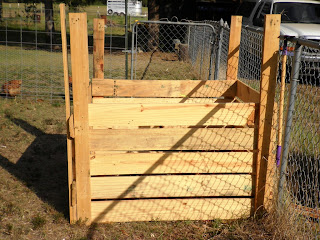
But then he got fancy. He built the front so that only the bottom board on that wall is permanently affixed. All the boards above it can be removed to lower the side. That will make shoveling material out of the box a whole lot easier on our backs.

Fire ants are a constant problem here, so the first thing we put in the bin was a thick layer of cedar mulch. Most bugs, including fire ants, don't like cedar. I don't think it's poisonous but it's not inviting to them either, so hopefully it will minimize their presence. After the layer of cedar mulch was in, Yeoldfurt pulled all of the old hay out of the chicken coop and piled it on top of the cedar. We put the hay in the coop in December to help the chickens stay warm through the winter. It was 'well-seasoned' and should be a bonus to our composting efforts.
My next problem was figuring out how to easily and efficiently gather household scraps on a daily basis to add to the compost. It's only the two of us and we only eat one meal at home on week days, so there isn't much to gather on a day to day basis. I didn't want to make too much of a chore out of 'feeding' the compost. I'm not looking for any new chores and if it's not convenient, it might not happen regularly. I also didn't want to deal with odors or a potential accidental spill if I accumulated too much before dumping the scraps. So here's what I came up with ...
I got one of the plastic coffee containers out of storage, the kind with the handle molded into one corner and a tight-fitting lid. I labeled it on the handle and the front and the lid 'COMPOST' and I keep it under the sink in my kitchen. Every night when I wash the coffee pot, I dump the old grounds in the can. When I crack an egg, the shell goes in the can. When I trim vegetables, the trimmings go in the can. Left over vegetables go in the can. Pretty much everything except meat goes in the can.
The coffee can is heavy plastic, very sturdy and easy to handle and has a tight-fitting lid so I don't have to worry about odor or spills. A bonus that I realized after the first week is that coffee grounds are a natural odor deterrent. I guess I knew that at one time but now it has real relevance. The last time I emptied the can, it had four days worth of coffee grounds, some bell pepper and onion trimmings, leftover corn and green beans and three egg shells. But the only thing I could smell when I opened the lid was the coffee grounds. What a plus!
Since keeping a compost pile wet is necessary for it to do it's job, I also started adding a little water to the can each time I put something in it. When I empty the can, I add water to within two inches of the top before I take it out to the compost bin. I give it a good swirl before I dump it which helps rinse the can. The added water with each deposit of scraps is good for the composting process so it's a win-win.
He has been disassembling the crates and pallets and stacking the lumber according to size and thickness. A couple of weeks ago, he used some of this free material to build us a really nice compost box. Before he started building it, we talked about what size it should be and where we should put it. We've had it for about two weeks now and, so far, I think we made some good choices. It's four feet square and the sides are about three feet tall. He set it up against the chainlink fence between the garden and the chicken coop. We figured that would be a convenient location both for putting new material in the box, and for getting material out of the box when it was time to build up the garden.
This is what it looks like. Notice that the four corner posts extend about two feet higher than the walls. He did that on purpose so that it would be easily expandable. If we run out of room, more boards can be added to the walls without him having to disassemble and reconstruct the whole box.

But then he got fancy. He built the front so that only the bottom board on that wall is permanently affixed. All the boards above it can be removed to lower the side. That will make shoveling material out of the box a whole lot easier on our backs.

Fire ants are a constant problem here, so the first thing we put in the bin was a thick layer of cedar mulch. Most bugs, including fire ants, don't like cedar. I don't think it's poisonous but it's not inviting to them either, so hopefully it will minimize their presence. After the layer of cedar mulch was in, Yeoldfurt pulled all of the old hay out of the chicken coop and piled it on top of the cedar. We put the hay in the coop in December to help the chickens stay warm through the winter. It was 'well-seasoned' and should be a bonus to our composting efforts.
My next problem was figuring out how to easily and efficiently gather household scraps on a daily basis to add to the compost. It's only the two of us and we only eat one meal at home on week days, so there isn't much to gather on a day to day basis. I didn't want to make too much of a chore out of 'feeding' the compost. I'm not looking for any new chores and if it's not convenient, it might not happen regularly. I also didn't want to deal with odors or a potential accidental spill if I accumulated too much before dumping the scraps. So here's what I came up with ...
I got one of the plastic coffee containers out of storage, the kind with the handle molded into one corner and a tight-fitting lid. I labeled it on the handle and the front and the lid 'COMPOST' and I keep it under the sink in my kitchen. Every night when I wash the coffee pot, I dump the old grounds in the can. When I crack an egg, the shell goes in the can. When I trim vegetables, the trimmings go in the can. Left over vegetables go in the can. Pretty much everything except meat goes in the can.
The coffee can is heavy plastic, very sturdy and easy to handle and has a tight-fitting lid so I don't have to worry about odor or spills. A bonus that I realized after the first week is that coffee grounds are a natural odor deterrent. I guess I knew that at one time but now it has real relevance. The last time I emptied the can, it had four days worth of coffee grounds, some bell pepper and onion trimmings, leftover corn and green beans and three egg shells. But the only thing I could smell when I opened the lid was the coffee grounds. What a plus!
Since keeping a compost pile wet is necessary for it to do it's job, I also started adding a little water to the can each time I put something in it. When I empty the can, I add water to within two inches of the top before I take it out to the compost bin. I give it a good swirl before I dump it which helps rinse the can. The added water with each deposit of scraps is good for the composting process so it's a win-win.
Saturday, April 9, 2011
Leather Cookies!
No, not the rawhide variety. Today had my first experiment adventure with making fruit leather. I cheated a little ...bought a jar of all natural applesauce, no sugar added. I know, I know ...much cheaper to buy the apples and make my own sauce. But my time is limited and at $1.29 for the jar, I think I made a wise decision. Until homesteading and prepping are my fulltime and only occupation, I have to make these choices sometimes.
Instead of making one big sheet of leather, I made 'cookies' approximately three inches in diameter. I used a tablespoon to dip the applesauce out of the jar, then spread it as evenly as possible with the back of the spoon. This is the before picture. I'll post an after picture this evening ...along with a taste test review.
 They look a little uneven in thickness here, but the applesauce was cold from the refrigerator when I spooned it onto the tray. The thicker parts will flatten a little as it warms up in the dehydrator, just as cookies flatten and spread in the oven. The instructions in the book that came with my dehydrator said to aim for 1/8-inch thickness in the center and 1/4-inch thickness on the edges when making fruit leathers. This is my first try, so we'll see how it turns out. The 'cookie' in the top right corner has a bit of homemade plum jelly stirred in. This is, after all, an experiment ...might as well try a couple variations! They should be ready in 4-6 hours. I set the timer for 5 hours and we'll see how they turn out.
In the meantime, Yeoldfurt and I have some saddle time planned for this morning. We've learned from experience to prioritize carefully on our days off. The first thing on the to-do list always gets accomplished ...the second thing usually gets accomplished. Anything further down the list has a fifty-fifty chance of not happening for one reason or another. Number One on the list today is some long overdue time in the saddle. Number Two (not as much fun) is the never-ending chore of fence maintenance. The leather cookies were just a wild hair I had while I was waiting for the sun to come up. It took five minutes to set them up in the dehydrator and now they're on auto-pilot. An easy bonus to whatever else we manage to accomplish today.
Instead of making one big sheet of leather, I made 'cookies' approximately three inches in diameter. I used a tablespoon to dip the applesauce out of the jar, then spread it as evenly as possible with the back of the spoon. This is the before picture. I'll post an after picture this evening ...along with a taste test review.

In the meantime, Yeoldfurt and I have some saddle time planned for this morning. We've learned from experience to prioritize carefully on our days off. The first thing on the to-do list always gets accomplished ...the second thing usually gets accomplished. Anything further down the list has a fifty-fifty chance of not happening for one reason or another. Number One on the list today is some long overdue time in the saddle. Number Two (not as much fun) is the never-ending chore of fence maintenance. The leather cookies were just a wild hair I had while I was waiting for the sun to come up. It took five minutes to set them up in the dehydrator and now they're on auto-pilot. An easy bonus to whatever else we manage to accomplish today.
Wednesday, April 6, 2011
Warm Fuzzies

These are the four newest members of the flock.
Yes, there are really four of them.
One is being shy and hiding behind the others.
We currently have three Rhode Island Reds that we bought in the spring of 2009. Their first eighteen months of production was great. They barely even slacked off during winter, producing 18 to 20 eggs every week. But for the past three or four months, we've been lucky to get 12 eggs in a week.
So we decided to try a different breed this time and bought these four Barred Plymouth Rock chicks. They are a dual purpose breed and have an excellent reputation for producing large brown eggs.
The chicks are staying cozy in the brood box in the garage for the next several weeks,
until they feather out and the nights get warmer.
In the meantime down at the coop, the rumor is slowly spreading that there are some new chicks in town.
So far, none of the incumbents seem to feel threatened ...at least they're not letting on if they are.
Do they look worried to you?
 |
| Reba |
 |
| Red |
 | |||
| Dora |
If hens can be cocky, these three surely qualify.
As far as they're concerned, the good life they're enjoying will go on forever.
Gee, that sounds like most of the politicians
we have these days!
Monday, February 21, 2011
Trying to Catch Up
Why is it that when you fall behind on something, it takes longer to regain the ground than it took you to lose it in the first place? I was off today for President's Day and managed to finish our taxes, catch up the laundry and the housework, and take care of some routine maintenance on the car. If I had been half as productive Saturday and Sunday, my list of what still needs doing would be a whole lot shorter. But the sun is going down and taking my last bit of motivation with it. Tomorrow it's back to the grindstone at the paying job.
Thanks to the nasty flu bug, Yeoldfurt and I have done next to nothing around here for the past two weeks except eat and sleep and occasionally (only recently) go to work. Other than feeding the menagerie and a bare minimum of housework, pretty much nothing got accomplished. We are finally starting to feel better but to look around at what needs to be done just to catch up makes me want to crawl back under the covers.
The garden is a mess but we're reconfiguring the raised beds this year, so it will be a late start anyway. The buckets we used last year need to be loosened and composted. Seeds need to be started. The fruit trees are budding and one is even flowering, so they need to be mulched and watered. The chicken coop needs to be raked out and the bedding composted for mulching the fruit trees. There's the never-ending fence projects and still plenty of downed trees to be cut up and hauled either to the burn pile or stacked for firewood. The iron hay ring we bought when we moved here in 2006 is rusting and falling apart. So next Saturday we're taking a road trip to our old home place to buy a new one. The one we're buying is galvanized and will probably last longer than we do. It's worth the trip and the price.
When we moved up here, we were raising Paint horses but the market for pleasure horses has tanked in the past couple of years. We will be venturing into the cattle business this coming year in order to maintain our Ag Exemption on the property. We'll buy three or four weanling calves this spring, raise them for up to six months, then put one in the freezer and sell the rest at the auction. It should pay for itself plus a little to spare but it's not as much about making a profit as it is about putting quality meat on the table and maintaining the tax exemption on the land. But that means we need to invest in a freezer this year too. It's something we've wanted to do for a while, and will be useful when the garden starts producing. I will be able to blanch and freeze vegetables as we harvest and wait until I have enough to make a whole day of canning worthwhile.
It's going to be a busy year and, I'm hoping, a bountiful one.
Thanks to the nasty flu bug, Yeoldfurt and I have done next to nothing around here for the past two weeks except eat and sleep and occasionally (only recently) go to work. Other than feeding the menagerie and a bare minimum of housework, pretty much nothing got accomplished. We are finally starting to feel better but to look around at what needs to be done just to catch up makes me want to crawl back under the covers.
The garden is a mess but we're reconfiguring the raised beds this year, so it will be a late start anyway. The buckets we used last year need to be loosened and composted. Seeds need to be started. The fruit trees are budding and one is even flowering, so they need to be mulched and watered. The chicken coop needs to be raked out and the bedding composted for mulching the fruit trees. There's the never-ending fence projects and still plenty of downed trees to be cut up and hauled either to the burn pile or stacked for firewood. The iron hay ring we bought when we moved here in 2006 is rusting and falling apart. So next Saturday we're taking a road trip to our old home place to buy a new one. The one we're buying is galvanized and will probably last longer than we do. It's worth the trip and the price.
When we moved up here, we were raising Paint horses but the market for pleasure horses has tanked in the past couple of years. We will be venturing into the cattle business this coming year in order to maintain our Ag Exemption on the property. We'll buy three or four weanling calves this spring, raise them for up to six months, then put one in the freezer and sell the rest at the auction. It should pay for itself plus a little to spare but it's not as much about making a profit as it is about putting quality meat on the table and maintaining the tax exemption on the land. But that means we need to invest in a freezer this year too. It's something we've wanted to do for a while, and will be useful when the garden starts producing. I will be able to blanch and freeze vegetables as we harvest and wait until I have enough to make a whole day of canning worthwhile.
It's going to be a busy year and, I'm hoping, a bountiful one.
Saturday, February 5, 2011
Snow Two Years in a Row
Snow is not a common occurrence in central Texas. To have a measurable snowfall two years in a row is really something. Moisture in any form is always welcome in a rural agricultural community. The sight of a thin blanket of snow over land that's been plagued with drought for several years running is beautiful. So as soon as Yeoldfurt had the water flowing again at the house, I took the camera and the dog and headed for the big pasture.
My excuse was to check fence which is always a good practice after any windy weather. But the truth is, I just wanted to forget the troubles of the last few days and enjoy the scenery. Since snow is so rare in these parts, winter here is usually dull and barren. Just dormant vegetation in multiple shades of brown against the variegated gray of winter skies. To see all that dullness dressed up in white from fresh fallen snow is just breathtaking while it lasts.
The catch pond had been completely dry most of the summer because of the drought. A week of heavy rain in November brought the water level about halfway back to normal again. Hopefully, we'll have better rainfall this spring and summer.

The thing about walking dogs in the country is that they get to lead the way. We take our dog with us whenever we walk the property or even if we just walk up to the road to get the mail. She never takes off and one word from either of us stops her in her tracks or brings her to our side. She's revels in the freedom of no leash and I smile at the freedom of having absolute control with no leash.

The purpose of the venture was to observe the winter landscape but it wasn't long before we were being observed by the horses.

Being herd animals, when one horse is interested enough to stop eating, instincts take over in the herd and it isn't long before the others are checking you out too.

If they all stop eating long enough to snort and stare, it won't be long until someone is elected to come check you out. Dancer being the low mare on the totem pole almost always draws the short straw. She circles off to my left, probably intended as a diversion.

Then the others move in from the opposite side. You remember these two from Devious Deeds, I'm sure! When things are boring, they pester one another so much you'd think they couldn't stand each other. But when an adventure is afoot, they are always together and always right in the middle of it. They move in to my right in an obvious attempt to flank me.
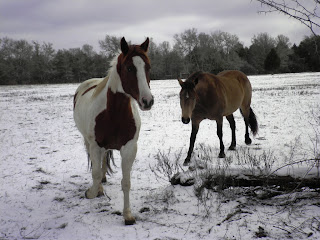
There were plenty of downed limbs on our property and the neighbors, but none that damaged the fenceline so it was just a nice walk in the woods. But after about 20 minutes, my face felt stiff from the cold so we headed back. I was cold and I could no longer feel my toes. But I was smiling because I knew I was going to be able to enjoy a long hot shower that evening ...all thanks to Yeoldfurt, my very own Dragon Slayer!
My excuse was to check fence which is always a good practice after any windy weather. But the truth is, I just wanted to forget the troubles of the last few days and enjoy the scenery. Since snow is so rare in these parts, winter here is usually dull and barren. Just dormant vegetation in multiple shades of brown against the variegated gray of winter skies. To see all that dullness dressed up in white from fresh fallen snow is just breathtaking while it lasts.
The catch pond had been completely dry most of the summer because of the drought. A week of heavy rain in November brought the water level about halfway back to normal again. Hopefully, we'll have better rainfall this spring and summer.

Looking back toward the house and barns, the snow was already starting to melt as the temperatures were finally above freezing. The afternoon forecast called for sunny skies and temperatures in the low forties.


The thing about walking dogs in the country is that they get to lead the way. We take our dog with us whenever we walk the property or even if we just walk up to the road to get the mail. She never takes off and one word from either of us stops her in her tracks or brings her to our side. She's revels in the freedom of no leash and I smile at the freedom of having absolute control with no leash.

The purpose of the venture was to observe the winter landscape but it wasn't long before we were being observed by the horses.

Being herd animals, when one horse is interested enough to stop eating, instincts take over in the herd and it isn't long before the others are checking you out too.

If they all stop eating long enough to snort and stare, it won't be long until someone is elected to come check you out. Dancer being the low mare on the totem pole almost always draws the short straw. She circles off to my left, probably intended as a diversion.

Then the others move in from the opposite side. You remember these two from Devious Deeds, I'm sure! When things are boring, they pester one another so much you'd think they couldn't stand each other. But when an adventure is afoot, they are always together and always right in the middle of it. They move in to my right in an obvious attempt to flank me.

I was never a threat to them and they were never a real threat to me or the dog. It was just a silly game of sneak attack, invented as a way to warm up on a cold winter day. Either they got bored because I wasn't playing 'scared' for them or they worked up an appetite from their little game because they were back to foraging in a matter of minutes and the dog and I continued our walk down the back fence line.
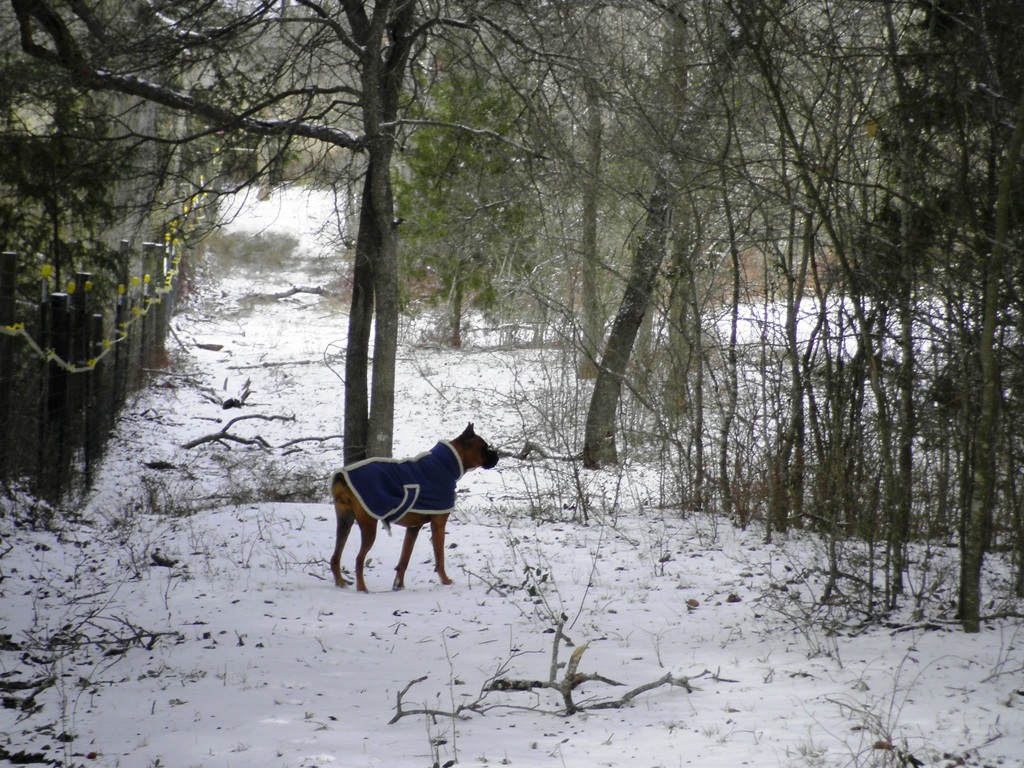
There were plenty of downed limbs on our property and the neighbors, but none that damaged the fenceline so it was just a nice walk in the woods. But after about 20 minutes, my face felt stiff from the cold so we headed back. I was cold and I could no longer feel my toes. But I was smiling because I knew I was going to be able to enjoy a long hot shower that evening ...all thanks to Yeoldfurt, my very own Dragon Slayer!
Friday, February 4, 2011
How It Really Was
Last night when Yeoldfurt came home from work, he was met at the door by a very bedraggled unhappy wife. We had been three full days without 'indoor plumbing.' I have been known to primitive camp for a long weekend from time to time and I have roughed it out of circumstance and necessity in a house with no lights or electricity for as much as a week a few times. But when I was camping and roughing it, I wasn't also trying to pull off a 'professional' appearance at an office job every day. This past week was tough. I am no barbie doll that has to have all the frills and froo-froo every day ...but that doesn't mean I have no standards for cleanliness. By the time Yeoldfurt got home from work last night, I was not clean, my floors were not clean, my counters were not clean, the laundry was piling up and I just had a melt down.
Yeoldfurt, being the gentlemanly knight that he is, let me blow off my steam and 'wring out my rag' as my sister calls it and then promised me it would get better. Today, he made good on that promise. It was still bitter cold but he was outside with my hair dryer first thing this morning, trying to thaw out the water line feeding the house.

It took quite a while but he finally got a drip going. It was slow at first, intermittent at times, but it was progress and I was happy. We left the spigot open and went in the house to warm up.
 We opened the taps in the house too so air could work its way out of the lines. Thirty minutes later, we had water. It was wonderful!
When Yeoldfurt mentioned in his first post this morning about HB not being happy ...he was understating the facts out of kindness to me. When he made light of his day's accomplishments in his last post this evening ('another dragon bites the dust'), he was just being humble. Ain't he sweet?
Yeoldfurt, being the gentlemanly knight that he is, let me blow off my steam and 'wring out my rag' as my sister calls it and then promised me it would get better. Today, he made good on that promise. It was still bitter cold but he was outside with my hair dryer first thing this morning, trying to thaw out the water line feeding the house.

It took quite a while but he finally got a drip going. It was slow at first, intermittent at times, but it was progress and I was happy. We left the spigot open and went in the house to warm up.

When Yeoldfurt mentioned in his first post this morning about HB not being happy ...he was understating the facts out of kindness to me. When he made light of his day's accomplishments in his last post this evening ('another dragon bites the dust'), he was just being humble. Ain't he sweet?
Thursday, January 20, 2011
Where to Begin
I don't think that either Yeoldfurt or I consider ourselves experts necessarily on prepping or long-term food storage. But since we started down this path a couple of years ago, we've learned a thing or two ...most of it the hard way. We've also accomplished a thing or two during that time. So since the real purpose of this blog is to share information, I'm going to try to share what we've learned. This post is my first installment on that effort.
Food and water are the most basic of necessities. Stockpiling these necessities is not a new concept but, in light of our floundering economy and rising costs, it is fast becoming a very popular one. There is so much to take into consideration when you decide to embrace this lifestyle. How many people are you planning to take care of ...for how long in a worst case scenario? Are you preparing for temporary hard times, or a full blown collapse of this economy? No one has a crystal ball and no can really prepare for every single contingency. You just have to take an objective look at your own situation, your own needs, and your own limitations and then do the best you can.
You will need space for your long-term storage. How many people you intend to take care of and for how long will determine how much space you need. Underestimating the space can be a serious pitfall. So calculate carefully and then round up on your estimations. I had a boss once that used to say, 'It always takes a third longer than you expect.' He was talking about estimating labor costs when bidding a contract, but I've found that 'a third longer' is a pretty good rule of thumb. So when you round up, round up by a third. It's much easier to find out you didn't need quite as much of a particular prep item, or didn't need quite as much storage space overall than it is to find out you needed much more.
There are two basic things you need to know before you can determine how much you need in terms of preps or storage space. You need to know how many people you are planning to support and for how long. Obviously you know how many people live in your household, but do you have extended family that you will accommodate if they show up on your doorstep? If so, it's much better to plan for them and have them not show up than to not plan for them and run short in a crisis. So decide how many people you want to accommodate in a worst case scenario. Next decide how many months worth you want to store. We decided on 12 months. The LDS church has always advocated a 12 month supply. It's long-term enough for you to get through most temporary personal crises and short-term enough to be manageable in terms of rotation. But I have known families who just keep a month or two ahead and other families that have literally years worth of staples. Decide what YOU are preparing for and plan accordingly.
Now that you know how many people you expect to accommodate and how long you expect to accommodate them in a worst case scenario, you can start your itemized list of what you will be storing. It can be mind-boggling at first. Somehow the hardest things to estimate for 12 month supply are the very things that are the most fundamentally essential to our daily life. Toilet paper is a good example. It's something we ALL use daily and would all miss dearly if it wasn't there. Yeoldfurt and I jokingly refer to it as 'rolled gold.' I say jokingly, but we take it very seriously. Off the top of your head, if you were new to prepping, would you KNOW how much toilet paper you would need per person for a 12 month supply? Before last year, I wouldn't have. For most people, their initial estimate would tend to be high because their estimate would be influenced by their keen desire not to be caught short. But investing more than you need of one item at some point robs you of the ability to invest enough in some other need. So it's important to be as realistic as possible in your estimation of quantities for all things. Breaking everything down into a one week or even a one day supply will simplify the task.
When we were just starting out, Yeoldfurt found a list online somewhere and built our list from that using Excel spreadsheet software. If you're building the list on the computer, any software will do ...but I highly recommend using a spreadsheet so you can easily sort. Most wordprocessing softwares will sort also if you set them up correctly, but it's not as user friendly. If you have spreadsheet software, that's definitely the best way to go.
Every item on Yeoldfurt's initial list was in alphabetical order. I decided early on that I needed to reorganize it into categories if I was going to be able to use it week to week. I also found that it included a lot of things that we didn't really use. Every family is different and has different needs. I'm the shopper and the cook in our household, so the list had to make sense to ME if I was going to be able to use it efficiently. Every person is different. Every family is different. You have to make sure the list fits your situation.
These are the eight categories that I used to organize our list:
Beverages & Related Condiments
Canned/Dried Goods
Cereals/Grains/Pastas/Stuffing
Cleaning Products/Chemicals
Condiments/Sauces/Salad Dressings
Cooking/Staples & Mixes
Personal Hygiene
Paper/Plastics/Foil
An inventory list is only useful if it's kept current. When I pull something out of storage, I write it down on my grocery list for the following week. Then a day or two before I plan to shop, I add any items from the inventory list that we're short of goal on. When I get home from shopping, I update the quantities on the spreadsheet. It's really very easy once you get in the habit.
Food and water are the most basic of necessities. Stockpiling these necessities is not a new concept but, in light of our floundering economy and rising costs, it is fast becoming a very popular one. There is so much to take into consideration when you decide to embrace this lifestyle. How many people are you planning to take care of ...for how long in a worst case scenario? Are you preparing for temporary hard times, or a full blown collapse of this economy? No one has a crystal ball and no can really prepare for every single contingency. You just have to take an objective look at your own situation, your own needs, and your own limitations and then do the best you can.
You will need space for your long-term storage. How many people you intend to take care of and for how long will determine how much space you need. Underestimating the space can be a serious pitfall. So calculate carefully and then round up on your estimations. I had a boss once that used to say, 'It always takes a third longer than you expect.' He was talking about estimating labor costs when bidding a contract, but I've found that 'a third longer' is a pretty good rule of thumb. So when you round up, round up by a third. It's much easier to find out you didn't need quite as much of a particular prep item, or didn't need quite as much storage space overall than it is to find out you needed much more.
There are two basic things you need to know before you can determine how much you need in terms of preps or storage space. You need to know how many people you are planning to support and for how long. Obviously you know how many people live in your household, but do you have extended family that you will accommodate if they show up on your doorstep? If so, it's much better to plan for them and have them not show up than to not plan for them and run short in a crisis. So decide how many people you want to accommodate in a worst case scenario. Next decide how many months worth you want to store. We decided on 12 months. The LDS church has always advocated a 12 month supply. It's long-term enough for you to get through most temporary personal crises and short-term enough to be manageable in terms of rotation. But I have known families who just keep a month or two ahead and other families that have literally years worth of staples. Decide what YOU are preparing for and plan accordingly.
Now that you know how many people you expect to accommodate and how long you expect to accommodate them in a worst case scenario, you can start your itemized list of what you will be storing. It can be mind-boggling at first. Somehow the hardest things to estimate for 12 month supply are the very things that are the most fundamentally essential to our daily life. Toilet paper is a good example. It's something we ALL use daily and would all miss dearly if it wasn't there. Yeoldfurt and I jokingly refer to it as 'rolled gold.' I say jokingly, but we take it very seriously. Off the top of your head, if you were new to prepping, would you KNOW how much toilet paper you would need per person for a 12 month supply? Before last year, I wouldn't have. For most people, their initial estimate would tend to be high because their estimate would be influenced by their keen desire not to be caught short. But investing more than you need of one item at some point robs you of the ability to invest enough in some other need. So it's important to be as realistic as possible in your estimation of quantities for all things. Breaking everything down into a one week or even a one day supply will simplify the task.
When we were just starting out, Yeoldfurt found a list online somewhere and built our list from that using Excel spreadsheet software. If you're building the list on the computer, any software will do ...but I highly recommend using a spreadsheet so you can easily sort. Most wordprocessing softwares will sort also if you set them up correctly, but it's not as user friendly. If you have spreadsheet software, that's definitely the best way to go.
Every item on Yeoldfurt's initial list was in alphabetical order. I decided early on that I needed to reorganize it into categories if I was going to be able to use it week to week. I also found that it included a lot of things that we didn't really use. Every family is different and has different needs. I'm the shopper and the cook in our household, so the list had to make sense to ME if I was going to be able to use it efficiently. Every person is different. Every family is different. You have to make sure the list fits your situation.
These are the eight categories that I used to organize our list:
Beverages & Related Condiments
Canned/Dried Goods
Cereals/Grains/Pastas/Stuffing
Cleaning Products/Chemicals
Condiments/Sauces/Salad Dressings
Cooking/Staples & Mixes
Personal Hygiene
Paper/Plastics/Foil
An inventory list is only useful if it's kept current. When I pull something out of storage, I write it down on my grocery list for the following week. Then a day or two before I plan to shop, I add any items from the inventory list that we're short of goal on. When I get home from shopping, I update the quantities on the spreadsheet. It's really very easy once you get in the habit.
Friday, December 31, 2010
Hope, for a Change
There is such a glut of bad news around the world and still so much wrong in this country. But our personal situation has improved so dramatically over the past few months that I can't help but feel a little optimistic as we approach the New Year. It's been so long since I felt anything even remotely resembling optimism that I'm reveling in it. That doesn't mean I think we should slow down on prepping. Quite the opposite. I'm more committed than ever to being prepared in every way possible ... for whatever may come.
We had barely begun our prepper lifestyle in 2008 when our personal situation took a nosedive. Tragedy seemed to be followed by one crisis after another. Little did we know at the time, it would be a full sixteen months before things would turn around for us. If we had not been prepping in earnest for those few months before the first crisis, we would not have come through as well as we have. But even during the long hard months, we added substantially to our skills and knowledge. During all but two or three of those months, we continually added to our preps as well. Last month, we finally reached our goal of a full 12-month supply of food and personal necessities. Now if we can just keep it organized! So this is my list for 2011.
First, my Challenge Goals ...things I hope to accomplish, believe I can accomplish, but know I will have to dog myself to get them all done.
PURGE
This will be my biggest challenge goal for the coming year. I want to purge, purge, purge, and then purge some more. I have accumulated a lot of STUFF over the years that has just followed me from place to place but never gets used or appreciated. These are things that are useful, just not being used. I keep them because they are sentimental ...they were my mother's or my grandmother's or my dad's ...all of whom are no longer in this world. I still have two sisters and as I sort through these things, I will give them first dibs on anything they want. What they don't want, I will find new homes for or give to charity. It is ridiculous and selfish to hang onto that much stuff if you are never going to use it. My mother, my grandmother and my dad would all heartily approve.
GET ORGANIZED
Once I whittle things down, I want to get what I keep ORGANIZED. I have a wonderful insulated, air conditioned storage shed that's subdivided into four rooms. All of the doorways between the rooms are open but the visual separation of the walls lends organization to the space and gives me plenty of room for shelves. The smallest of the rooms is approximately 10x10 and the slab in this room is about 8 inches lower than the other rooms. We call it the Step Down and it's where we have our food stores. Between the air conditioner and the insulation, everything stays dark and cool year 'round. It's as close to 'root cellar' conditions as you can get in central Texas, and is ideal for long-term food storage. The rest of the space is approximately 20x20, divided into three rooms. Those three rooms are half to three-quarter full now, but everything is just piled in there in no apparent order. The only reason I have any clue as to what's in there is because I had to shuffle things around when we prepared the Step Down for food storage earlier this year. The food storage room looks great. Now it's time to organize the rest of the space.
MINIMIZE (me)
On a personal level, I want to shed some weight this coming year. Besides the obvious health benefits, I have the motivation of a closet full of clothes that I used to be able to wear! I started working on this back in June and am nearing the halfway mark. I've lost enough to feel motivated and encouraged to continue. And now that the two big EATING and COOKING holidays are behind us ...I'm hoping the last half of this goal will be easier than the first half!
So much for my Challenge Goals, now for my Standard Goals. These are the ones that will pretty much stay on the list year after year in one form or another because ...well, because we are preppers. That's what we do.
RECONFIGURE RAISED BED GARDEN
It's currently arranged as one 16x16 bed with 'walk boards (1x12's) dividing it into eight sections. Yeoldfurt wants to dismantle it and set it up as four separate beds with wider walkways between them. He has some wonderful salvage goods from his work that will be used to line the walkways. We are discussing ways to build them up (deeper) as well. They are currently 8 inches deep, and I would like to get them to 12 or even 16 inches deep. More 'leg room' for the veggies but also not as far to bend down for me! Always thinkin'....
Our first year with the raised beds was 2009 and we had a nice harvest in spite of a delay in planting and all the emotional turmoil we had that year. We had high hopes for the harvest in 2010, but were somewhat disappointed in the outcome. The crops that did great the year before were so-so this year and the only thing that did really spectacular was the cucumbers. I now have almost 40 pints of pickles from one 3x7 bed. The weeds, the ants, and the grasshoppers were all a constant battle last year. We are hoping to improve the odds in our favor by reconfiguring the beds and improving accessibility while minimizing backstrain. Yeoldfurt has been talking about a mobile dripline watering system and we also have a possible solution for the ants and weeds that is cheap, eco-friendly and recyclable.
IMPROVE CHICKEN COOP
I'm still in the thinking stages about this one so Yeoldfurt might raise an eyebrow when he reads about it here. My ideas are usually born half-baked and go through a gazillion or so gyrations before they finally evolve into a real plan. I'm used to the way I think, so it doesn't bother me to start out with Plan A and finally end up doing Plan Q. It's a woman's perrogative to change her mind, right? It's another one of those Venus things. But I've learned it's best to think on them for a long time before I approach Yeoldfurt. The first few years of marriage taught me pretty quick that he stresses out way too much on these kinds of mental journeys. So I try not to even mention my ideas to him until I'm a good ways into the alphabet and am pretty sure I'm done changing my mind about things.
My ideas for the coop are not labor intensive or expensive, and nothing I can't do all by myself if Yeoldfurt wants to turn me loose on it. I think we're both happy with the structure and design of the existing coop. But we have had two chicken snakes stealing eggs so far this year. There may have been more, we just didn't happen to catch them. We know how they got into the coop and Yeoldfurt has taken some steps to rectify that. But since I'm the one that's squeamish about snakes and really not wanting to deal with that again, I've got a few more ideas on the subject. I also want to fix a 'nursery' in one end of the coop. There's a section at one end that the previous owners here used to raise parakeets. It's about 4x4 with a walk-through door leading into the main coop. We have a free-standing broodbox that we bought as a kit from Tractor Supply (half price because the box was damaged ...only paid $25) and I want to modify it to mount to the wall in the small room in the coop. Being a relatively small area, if I cover the walls with insulating material, it would be easy to keep warm as a nursery area for young chicks. Just some ideas. I also want to break up the floor in the coop, bring in new sand and just generally clean things up. See? Nothing real major!
DEBT
Get rid of it. That's the goal. We don't have any other than the mortgage and we want to get rid of that as soon as possible. We have a 30 year fixed rate mortgage with a decent rate, but I would have loved to have refinanced when rates were at their lowest last summer. We pay extra every month and are on track to pay off the 30 year mortgage in less than 20 years ...but being able to refinance at an even lower rate would have made the pay off that much quicker. Now that Yeoldfurt is employed again, we will talk to a local bank (locally owned and on the 'good bank' list) about refinancing. Even if we only drop a fraction of a percent on the interest rate, it will be worth it to get away from the BIG BANK.
INCREASE
I'm happy with where our food stores are now. A 12-month supply is as much as I want to try to keep track of to ensure nothing gets wasted. But I would like to add to our cash reserves and increase any nonperishable non-foodstuffs ...oh, say ammo and reloading supplies, for instance? Now I know Yeoldfurt's eyes will light up at that! Ha!
NEW SKILLS / KNOWLEDGE
You can never have enough of either of these things, in my opinion. Last year, we learned to make our own laundry soap. This year, I hope to add shampoo, conditioner and liquid body wash to our soap making repertoire. We still have a dozen or so dead trees from last year's drought that need to be felled and Yeoldfurt has promised to let me give it a whirl. Not that cutting a tree down is rocket science, but having it land where you want it ...or not land where you don't want it requires some knowledge and skill and I think it would be something useful for me to learn. But I'm pretty sure he'll want me to practice on the ones farthest from the house and fences though ...yeah, I'm pretty sure.
So that's it, my formal list for the coming year. I decided to post it partly to help me think it through and partly in hopes it will keep me honest. I've never been much more than haphazard about New Year's Resolutions ...either setting them or following up when I do set them. But maybe if I get serious about setting some goals ...publicly committing to my goals ...just maybe I'll be more serious about the 'following up' part as well.
So for 2011, let's prepare for the worst but hope for the best. May we all have a blessed New Year!
We had barely begun our prepper lifestyle in 2008 when our personal situation took a nosedive. Tragedy seemed to be followed by one crisis after another. Little did we know at the time, it would be a full sixteen months before things would turn around for us. If we had not been prepping in earnest for those few months before the first crisis, we would not have come through as well as we have. But even during the long hard months, we added substantially to our skills and knowledge. During all but two or three of those months, we continually added to our preps as well. Last month, we finally reached our goal of a full 12-month supply of food and personal necessities. Now if we can just keep it organized! So this is my list for 2011.
First, my Challenge Goals ...things I hope to accomplish, believe I can accomplish, but know I will have to dog myself to get them all done.
PURGE
This will be my biggest challenge goal for the coming year. I want to purge, purge, purge, and then purge some more. I have accumulated a lot of STUFF over the years that has just followed me from place to place but never gets used or appreciated. These are things that are useful, just not being used. I keep them because they are sentimental ...they were my mother's or my grandmother's or my dad's ...all of whom are no longer in this world. I still have two sisters and as I sort through these things, I will give them first dibs on anything they want. What they don't want, I will find new homes for or give to charity. It is ridiculous and selfish to hang onto that much stuff if you are never going to use it. My mother, my grandmother and my dad would all heartily approve.
GET ORGANIZED
Once I whittle things down, I want to get what I keep ORGANIZED. I have a wonderful insulated, air conditioned storage shed that's subdivided into four rooms. All of the doorways between the rooms are open but the visual separation of the walls lends organization to the space and gives me plenty of room for shelves. The smallest of the rooms is approximately 10x10 and the slab in this room is about 8 inches lower than the other rooms. We call it the Step Down and it's where we have our food stores. Between the air conditioner and the insulation, everything stays dark and cool year 'round. It's as close to 'root cellar' conditions as you can get in central Texas, and is ideal for long-term food storage. The rest of the space is approximately 20x20, divided into three rooms. Those three rooms are half to three-quarter full now, but everything is just piled in there in no apparent order. The only reason I have any clue as to what's in there is because I had to shuffle things around when we prepared the Step Down for food storage earlier this year. The food storage room looks great. Now it's time to organize the rest of the space.
MINIMIZE (me)
On a personal level, I want to shed some weight this coming year. Besides the obvious health benefits, I have the motivation of a closet full of clothes that I used to be able to wear! I started working on this back in June and am nearing the halfway mark. I've lost enough to feel motivated and encouraged to continue. And now that the two big EATING and COOKING holidays are behind us ...I'm hoping the last half of this goal will be easier than the first half!
So much for my Challenge Goals, now for my Standard Goals. These are the ones that will pretty much stay on the list year after year in one form or another because ...well, because we are preppers. That's what we do.
RECONFIGURE RAISED BED GARDEN
It's currently arranged as one 16x16 bed with 'walk boards (1x12's) dividing it into eight sections. Yeoldfurt wants to dismantle it and set it up as four separate beds with wider walkways between them. He has some wonderful salvage goods from his work that will be used to line the walkways. We are discussing ways to build them up (deeper) as well. They are currently 8 inches deep, and I would like to get them to 12 or even 16 inches deep. More 'leg room' for the veggies but also not as far to bend down for me! Always thinkin'....
Our first year with the raised beds was 2009 and we had a nice harvest in spite of a delay in planting and all the emotional turmoil we had that year. We had high hopes for the harvest in 2010, but were somewhat disappointed in the outcome. The crops that did great the year before were so-so this year and the only thing that did really spectacular was the cucumbers. I now have almost 40 pints of pickles from one 3x7 bed. The weeds, the ants, and the grasshoppers were all a constant battle last year. We are hoping to improve the odds in our favor by reconfiguring the beds and improving accessibility while minimizing backstrain. Yeoldfurt has been talking about a mobile dripline watering system and we also have a possible solution for the ants and weeds that is cheap, eco-friendly and recyclable.
IMPROVE CHICKEN COOP
I'm still in the thinking stages about this one so Yeoldfurt might raise an eyebrow when he reads about it here. My ideas are usually born half-baked and go through a gazillion or so gyrations before they finally evolve into a real plan. I'm used to the way I think, so it doesn't bother me to start out with Plan A and finally end up doing Plan Q. It's a woman's perrogative to change her mind, right? It's another one of those Venus things. But I've learned it's best to think on them for a long time before I approach Yeoldfurt. The first few years of marriage taught me pretty quick that he stresses out way too much on these kinds of mental journeys. So I try not to even mention my ideas to him until I'm a good ways into the alphabet and am pretty sure I'm done changing my mind about things.
My ideas for the coop are not labor intensive or expensive, and nothing I can't do all by myself if Yeoldfurt wants to turn me loose on it. I think we're both happy with the structure and design of the existing coop. But we have had two chicken snakes stealing eggs so far this year. There may have been more, we just didn't happen to catch them. We know how they got into the coop and Yeoldfurt has taken some steps to rectify that. But since I'm the one that's squeamish about snakes and really not wanting to deal with that again, I've got a few more ideas on the subject. I also want to fix a 'nursery' in one end of the coop. There's a section at one end that the previous owners here used to raise parakeets. It's about 4x4 with a walk-through door leading into the main coop. We have a free-standing broodbox that we bought as a kit from Tractor Supply (half price because the box was damaged ...only paid $25) and I want to modify it to mount to the wall in the small room in the coop. Being a relatively small area, if I cover the walls with insulating material, it would be easy to keep warm as a nursery area for young chicks. Just some ideas. I also want to break up the floor in the coop, bring in new sand and just generally clean things up. See? Nothing real major!
DEBT
Get rid of it. That's the goal. We don't have any other than the mortgage and we want to get rid of that as soon as possible. We have a 30 year fixed rate mortgage with a decent rate, but I would have loved to have refinanced when rates were at their lowest last summer. We pay extra every month and are on track to pay off the 30 year mortgage in less than 20 years ...but being able to refinance at an even lower rate would have made the pay off that much quicker. Now that Yeoldfurt is employed again, we will talk to a local bank (locally owned and on the 'good bank' list) about refinancing. Even if we only drop a fraction of a percent on the interest rate, it will be worth it to get away from the BIG BANK.
INCREASE
I'm happy with where our food stores are now. A 12-month supply is as much as I want to try to keep track of to ensure nothing gets wasted. But I would like to add to our cash reserves and increase any nonperishable non-foodstuffs ...oh, say ammo and reloading supplies, for instance? Now I know Yeoldfurt's eyes will light up at that! Ha!
NEW SKILLS / KNOWLEDGE
You can never have enough of either of these things, in my opinion. Last year, we learned to make our own laundry soap. This year, I hope to add shampoo, conditioner and liquid body wash to our soap making repertoire. We still have a dozen or so dead trees from last year's drought that need to be felled and Yeoldfurt has promised to let me give it a whirl. Not that cutting a tree down is rocket science, but having it land where you want it ...or not land where you don't want it requires some knowledge and skill and I think it would be something useful for me to learn. But I'm pretty sure he'll want me to practice on the ones farthest from the house and fences though ...yeah, I'm pretty sure.
So that's it, my formal list for the coming year. I decided to post it partly to help me think it through and partly in hopes it will keep me honest. I've never been much more than haphazard about New Year's Resolutions ...either setting them or following up when I do set them. But maybe if I get serious about setting some goals ...publicly committing to my goals ...just maybe I'll be more serious about the 'following up' part as well.
So for 2011, let's prepare for the worst but hope for the best. May we all have a blessed New Year!
Wednesday, December 1, 2010
The Devil is in the Details
Yeoldfurt and I are 'list people' in just about every aspect of our lives. We have Grocery lists, To Do lists, and Wish lists so something as important as food storage, of course, had to have a list too. Yeoldfurt set up our original inventory list on a spreadsheet almost two years ago. He gave every item its own row with five columns. The first column gives a detailed description of the item and units of measure (i.e., pinto beans / lbs or tea bags / total). The second column is the amount of that item we estimate we would use in one year's time. The third column is the quantity we have on-hand of that item, and the fourth column is the difference between the two. The fourth column is the one we refer to most when we make our shopping list. The last column is the date that item was updated. He alphabetized the whole list by the first column. Alphabetized by item has worked okay. But since I'm usually the shopper and almost always the cook, I thought it would be more user-friendly for me if I categorized the items similar to the way a grocery store is set up and Yeoldfurt let me do my thing. So I revamped his spreadsheet, putting each item into a category ...similar to the way the aisles are categorized in a grocery store ...then alphabetized the items within that category. I like this set up much better.
Since our food storage is in a separate building on our property and I'm usually making my grocery list late at night or in the pre-dawn hours, it's important to me that I can trust our inventory list. So when we moved all of our food storage to the new location a few weeks ago, I did a complete count after everything was set up and now am totally confident that our inventory list is accurate. It's a great feeling to really know what you have and what you still need to get more of.
This weekend, we are going to make a run to Sam's and complete our inventory ...or try. Hopefully we won't break the bank. We are up to goal on more than half of the items on the list and not too far short on others. So I'm hopeful. Knowing a twelve month supply of food and all essentials are safely in storage would sure be a great way to start the new year.
They say the devil is in the details, so if you have food stored, I urge you to keep it well organized and maintain an accurate, up to date inventory. Once the crisis is upon you, it's too late to get organized. You can try ...you probably would try ...but you won't be clear-headed and you won't make decisions as well as you would if you weren't under stress. Whether you're faced with a personal set back like the loss of an income or a much bigger crisis like regional interruptions of goods and services, the better you are organized and prepared, the better you will fare.
Since our food storage is in a separate building on our property and I'm usually making my grocery list late at night or in the pre-dawn hours, it's important to me that I can trust our inventory list. So when we moved all of our food storage to the new location a few weeks ago, I did a complete count after everything was set up and now am totally confident that our inventory list is accurate. It's a great feeling to really know what you have and what you still need to get more of.
This weekend, we are going to make a run to Sam's and complete our inventory ...or try. Hopefully we won't break the bank. We are up to goal on more than half of the items on the list and not too far short on others. So I'm hopeful. Knowing a twelve month supply of food and all essentials are safely in storage would sure be a great way to start the new year.
They say the devil is in the details, so if you have food stored, I urge you to keep it well organized and maintain an accurate, up to date inventory. Once the crisis is upon you, it's too late to get organized. You can try ...you probably would try ...but you won't be clear-headed and you won't make decisions as well as you would if you weren't under stress. Whether you're faced with a personal set back like the loss of an income or a much bigger crisis like regional interruptions of goods and services, the better you are organized and prepared, the better you will fare.
Monday, November 8, 2010
Two Steps Forward, One Step Back
Saturday is the only day we're both off work, so we try to make it count. The big project this past Saturday was to move the food stores from their present location to the new area we had prepared. It took us most of the morning to get it all moved, but we got it done. The new storage area is a bit closer to the house which is a big bonus for me. As the primary cook and shopper for this outfit, I'm the one that is usually in and out of there on a regular basis. The biggest bonus for Yeoldfurt is having his shop back. I believe every man should have his own shop, and he ought not have to share the space for any purpose than his own.
We were pretty pleased with ourselves for having accomplished a big goal, but then some unexpected trouble with one of the vehicles threatened to put a damper on the mood. We got ready to go into town for supper to celebrate our anniversary this past week, only to discovered there was a problem with one of the trucks. The big truck is a diesel and, hence, has two batteries ...both dead as doornails. Dead batteries certainly explained the truck refusing to start, but it does have over 100,000 miles on it and all of the components of the starting system are still factory original. So since we have towing coverage on our insurance, we decided the best course of action was to have it towed to the shop Monday morning and have everything checked out. We are both scheduled to work on Mondays, but one of us would have to stay home to meet the wrecker and wait on the truck. Yeoldfurt is off on Tuesdays and could have requested to switch his days so he could be home on Monday. But if something besides the batteries was wrong, it might take longer than the one day and we would have the same transportation problem on Tuesday. I've been at my job almost two years and have plenty personal leave accrued so we decided I would be the one to stay home. I'll drive the other truck to work tomorrow and stop by the shop on the way home to pay the bill. Then Yeoldfurt and I will go back to town tomorrow evening to bring the other truck home so we can both go to work Wednesday morning.
After Yeoldfurt left for work Sunday morning, I set about organizing the food in the new space and doing a real inventory. Our goal is to accumulate and maintain a 6-12 month food supply. We don't count what's in the cupboards in the house on the inventory. Once an item leaves the storage area, it's subtracted from the inventory even if we don't use it up in the house for a week or month. The new storage is also a lot more space which makes organizing and keeping track of what we have a whole lot easier. The new storage room is approximately 12 x 12, with sturdy wooden shelves on three of the walls. The shelves run the full length on two of the walls, and 18 inches short of the length on the third wall. I use that unshelved bit of wall to hang a wisk broom, dustpan and store a step ladder. We have two plastic shelving units in the room as well. One of them is set up with four shelves and the other is set up as two separate two shelf units that I placed underneath the wooden shelves. I have stored non-edibles such as cleaning supplies, aluminum foil, sterno, and assorted soaps and shampoos on all the lower plastic shelves. The rest of the food items are organized by categories that make sense to me since I am the one that will usually be looking for what I need. The only items that still remain to be moved are paper goods ...the ever-important toilet paper and convenience items such as paper towel, paper plates and paper bowls. We will store a year's supply in plastic crates but since those items don't 'expire' like food stuffs, we won't rotate them when I do grocery shopping. Home-canned foods will be stored in the house for now simply because I have the space and it's more convenient to put them in the cupboard after I process them, than to tote them all down to the food storage room.
So it was a good weekend as far as accomplishing what we set out to do, and a frustrating weekend because of unexpected vehicle expenses. Two steps forward, one step back. But as much as I dislike having to spend money on unexpected repairs, I'm grateful that both trucks are paid for and have been for years. The occasional repair bill is a whole lot easier to swallow than monthly truck payments.
We were pretty pleased with ourselves for having accomplished a big goal, but then some unexpected trouble with one of the vehicles threatened to put a damper on the mood. We got ready to go into town for supper to celebrate our anniversary this past week, only to discovered there was a problem with one of the trucks. The big truck is a diesel and, hence, has two batteries ...both dead as doornails. Dead batteries certainly explained the truck refusing to start, but it does have over 100,000 miles on it and all of the components of the starting system are still factory original. So since we have towing coverage on our insurance, we decided the best course of action was to have it towed to the shop Monday morning and have everything checked out. We are both scheduled to work on Mondays, but one of us would have to stay home to meet the wrecker and wait on the truck. Yeoldfurt is off on Tuesdays and could have requested to switch his days so he could be home on Monday. But if something besides the batteries was wrong, it might take longer than the one day and we would have the same transportation problem on Tuesday. I've been at my job almost two years and have plenty personal leave accrued so we decided I would be the one to stay home. I'll drive the other truck to work tomorrow and stop by the shop on the way home to pay the bill. Then Yeoldfurt and I will go back to town tomorrow evening to bring the other truck home so we can both go to work Wednesday morning.
After Yeoldfurt left for work Sunday morning, I set about organizing the food in the new space and doing a real inventory. Our goal is to accumulate and maintain a 6-12 month food supply. We don't count what's in the cupboards in the house on the inventory. Once an item leaves the storage area, it's subtracted from the inventory even if we don't use it up in the house for a week or month. The new storage is also a lot more space which makes organizing and keeping track of what we have a whole lot easier. The new storage room is approximately 12 x 12, with sturdy wooden shelves on three of the walls. The shelves run the full length on two of the walls, and 18 inches short of the length on the third wall. I use that unshelved bit of wall to hang a wisk broom, dustpan and store a step ladder. We have two plastic shelving units in the room as well. One of them is set up with four shelves and the other is set up as two separate two shelf units that I placed underneath the wooden shelves. I have stored non-edibles such as cleaning supplies, aluminum foil, sterno, and assorted soaps and shampoos on all the lower plastic shelves. The rest of the food items are organized by categories that make sense to me since I am the one that will usually be looking for what I need. The only items that still remain to be moved are paper goods ...the ever-important toilet paper and convenience items such as paper towel, paper plates and paper bowls. We will store a year's supply in plastic crates but since those items don't 'expire' like food stuffs, we won't rotate them when I do grocery shopping. Home-canned foods will be stored in the house for now simply because I have the space and it's more convenient to put them in the cupboard after I process them, than to tote them all down to the food storage room.
So it was a good weekend as far as accomplishing what we set out to do, and a frustrating weekend because of unexpected vehicle expenses. Two steps forward, one step back. But as much as I dislike having to spend money on unexpected repairs, I'm grateful that both trucks are paid for and have been for years. The occasional repair bill is a whole lot easier to swallow than monthly truck payments.
Sunday, November 7, 2010
Baked Fresh from the Freezer
About a year ago, I started making my own bread to save money. I found a couple of recipes I liked and would make one or two batches every other weekend or so, baking the loaves and putting them in the freezer. But we have limited freezer space and bread takes up considerable room. Since bread dough before the final rise is only approximately half the volume of a baked loaf, I started trying to figure out how to freeze bread dough that could be baked as needed.
My first resource is always my network prepper friends, but no one had any advice to offer on the subject. My research online was somewhat successful, but a few sites said any bread dough could be frozen before the final rise and others said you had to double the yeast in the recipe as some of the yeast would die off in the freezing process. Yeast is relatively expensive and doubling any ingredient in a recipe increases the cost of the final product. Since I was making my own bread in the first place as a money saving measure, increasing my cost didn't appeal to me. So I decided I would experiment with my usual recipe, using just the normal amount of yeast.
For my first experiment, I made a batch of Pepper Bread dough just as I always do and, before the final rise, I put the dough in a loaf-size baggie and placed it a loaf pan, then put the pan in the freezer. I patted the bagged dough flat after it was in the pan so it was no more than an inch thick as some websites suggested it would freeze and thaw more evenly at that thickness. About three hours later, the bread dough was frozen solid so I removed the loaf pans and just left the frozen dough in baggies in the freezer. The baggies of frozen dough took up only half as much freezer space as one loaf of baked bread ...my first objective of saving freezer space was looking successful!
At 6:00am the next morning when I was ready to leave for work, I put one of the baggie of the dough in the refrigerator to begin thawing. When I got home from work at 4:30, the dough was soft and pliable. I placed it in a greased loaf pan in my dehydrator to begin the final rise. An hour and a half later, it had doubled in size and was ready to bake. When Yeoldfurt got home that night, he had fresh-baked bread with his supper.
For my second experiment, I decided to try freezing the dough in two- to four-inch balls so I could make individual or cloverleaf rolls. I froze the two-inch dough balls two to a sandwich-size baggie and the four-inch balls one to a sandwich-size baggie. Then I put all of the sandwich baggies of dough balls in a larger loaf-size baggie. When I wanted hot rolls for a meal, I put however many sandwich-size baggies I needed in the refrigerator overnight to thaw, then let them rise and baked them fresh the day I was serving them. I used a muffin tin to bake the four-inch balls and a mini-loaf tin to bake the two-inch balls (two balls per mini-loaf slot). If you want cloverleaf dinner rolls, place three two-inch balls to a muffin slot.
Use your imagination. Remember pull-apart loaves of bread? Just use the four-inch balls, pat them flat and stack them vertically in a greased loaf pan. When the loaf is baked, the individual segments will pull apart easily into slices.
Making bread dough can get messy, especially in a small kitchen. Being able to make a double or triple batch and just freeze the dough for when you need it means you only make and clean up one mess instead of two or three. I'm all for saving clean up time!
My first resource is always my network prepper friends, but no one had any advice to offer on the subject. My research online was somewhat successful, but a few sites said any bread dough could be frozen before the final rise and others said you had to double the yeast in the recipe as some of the yeast would die off in the freezing process. Yeast is relatively expensive and doubling any ingredient in a recipe increases the cost of the final product. Since I was making my own bread in the first place as a money saving measure, increasing my cost didn't appeal to me. So I decided I would experiment with my usual recipe, using just the normal amount of yeast.
For my first experiment, I made a batch of Pepper Bread dough just as I always do and, before the final rise, I put the dough in a loaf-size baggie and placed it a loaf pan, then put the pan in the freezer. I patted the bagged dough flat after it was in the pan so it was no more than an inch thick as some websites suggested it would freeze and thaw more evenly at that thickness. About three hours later, the bread dough was frozen solid so I removed the loaf pans and just left the frozen dough in baggies in the freezer. The baggies of frozen dough took up only half as much freezer space as one loaf of baked bread ...my first objective of saving freezer space was looking successful!
At 6:00am the next morning when I was ready to leave for work, I put one of the baggie of the dough in the refrigerator to begin thawing. When I got home from work at 4:30, the dough was soft and pliable. I placed it in a greased loaf pan in my dehydrator to begin the final rise. An hour and a half later, it had doubled in size and was ready to bake. When Yeoldfurt got home that night, he had fresh-baked bread with his supper.
For my second experiment, I decided to try freezing the dough in two- to four-inch balls so I could make individual or cloverleaf rolls. I froze the two-inch dough balls two to a sandwich-size baggie and the four-inch balls one to a sandwich-size baggie. Then I put all of the sandwich baggies of dough balls in a larger loaf-size baggie. When I wanted hot rolls for a meal, I put however many sandwich-size baggies I needed in the refrigerator overnight to thaw, then let them rise and baked them fresh the day I was serving them. I used a muffin tin to bake the four-inch balls and a mini-loaf tin to bake the two-inch balls (two balls per mini-loaf slot). If you want cloverleaf dinner rolls, place three two-inch balls to a muffin slot.
Use your imagination. Remember pull-apart loaves of bread? Just use the four-inch balls, pat them flat and stack them vertically in a greased loaf pan. When the loaf is baked, the individual segments will pull apart easily into slices.
Making bread dough can get messy, especially in a small kitchen. Being able to make a double or triple batch and just freeze the dough for when you need it means you only make and clean up one mess instead of two or three. I'm all for saving clean up time!
Subscribe to:
Posts (Atom)